Before you go...
We built a free scorecard that shows how your heat pump, ventilation and solar systems are performing. Results are usually surprising.
Get my score
No thanks
We built a free scorecard that shows how your heat pump, ventilation and solar systems are performing. Results are usually surprising.
No thanksWe built a free scorecard that shows how your heat pump, ventilation and solar systems are performing. Results are usually surprising.
No thanks
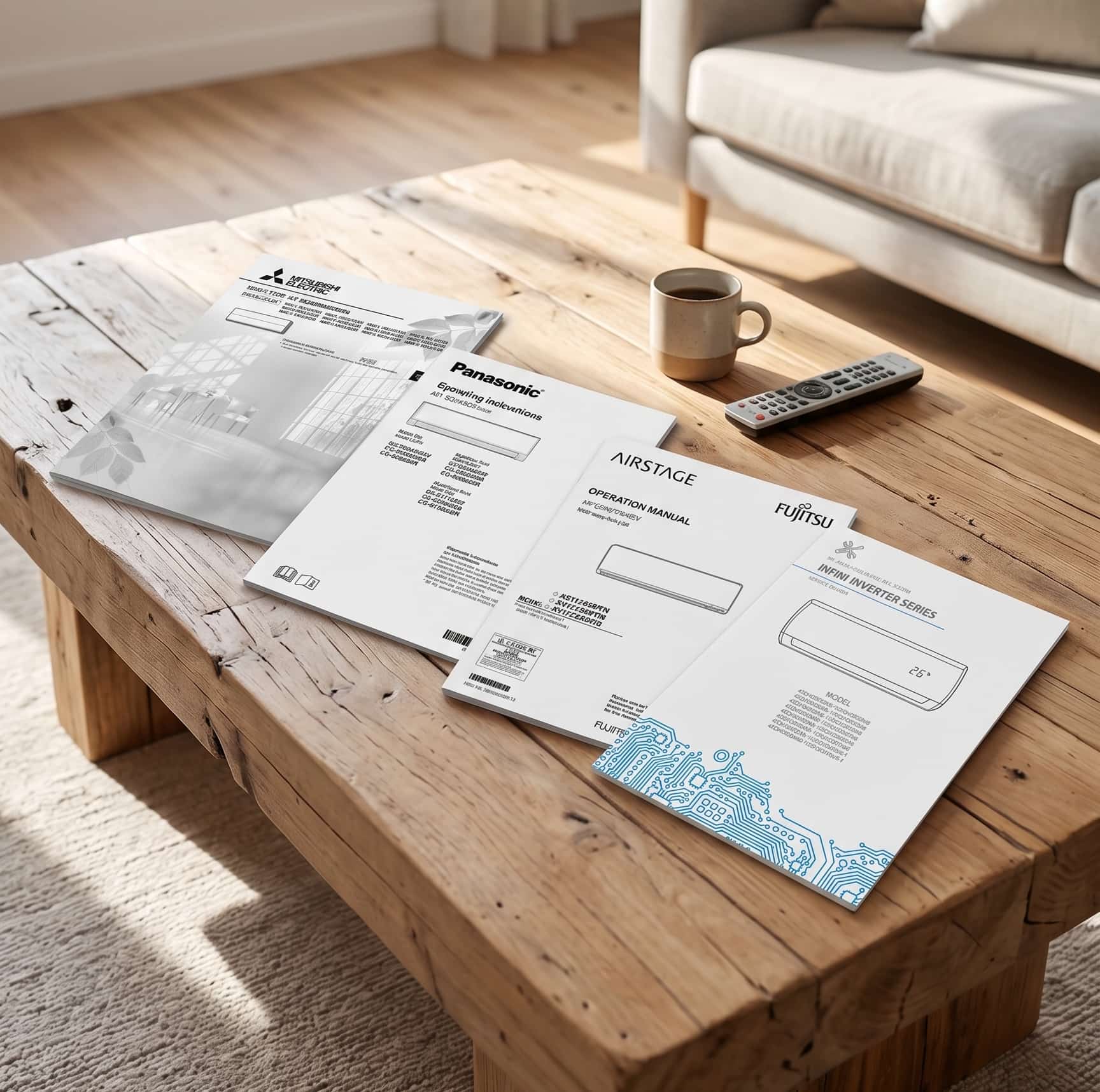
If you are searching for a heat pump manual, you are probably not looking to read the whole document cover to cover. You want to know what a specific error means, what the service interval section actually says, or whether your system is old enough that no documentation exists online anymore. This guide covers all of that, brand by brand, without you needing to find the document first.
Finding your manual starts with the model number on your indoor unit. It is printed on a label inside the front panel or along the side of the unit, typically in a format like MSZ-AP25 or FTXM25. Note that down before you search.
Go to mitsubishi-electric.co.nz/manuals.aspx and select Heat Pumps / Air Conditioning. Mitsubishi Electric NZ publishes owner guides and operation manuals for current and recent models. The MSZ-GE, MSZ-AP, and MSZ-EF series are all represented. If your model is older, try the global support portal at mitsubishielectric.com. Mitsubishi Electric also publishes a separate remote controller operation manual, which covers the wireless remote in more detail than the main owner guide.
Go to mhiheatpumps.co.nz/support/user-manuals. MHI publishes a searchable database of user manuals by product series and model number. Note that Mitsubishi Heavy Industries and Mitsubishi Electric are separate companies with different products, remotes, and documentation.
Go to daikin.co.nz/operation-manuals and search by model number. Daikin NZ supports the FTXM and FTXS inverter series with full documentation. If your unit is not listed, the global resource at daikin.com carries a wider archive.
Go to generalairstage.co.nz/help-centre/product-manuals. Fujitsu General rebranded to General Airstage in NZ — the support pages are now under the General Airstage domain. Operation manuals for the ASTG series and current residential models are available here.
Go to panasonic.com/nz/support/manual-download.html. Panasonic NZ publishes downloadable manuals for current and recent heat pump models across the CS-Z and CS-E series.
Go to hitachiaircon.com/nz/resources and navigate to the heat pumps section. Hitachi NZ publishes operation manuals for the airHome 400, 500, and 600 series. A separate documentation portal at documentation.hitachiaircon.com/nz/en carries the full technical and service documentation library.
Toshiba aircon in NZ is distributed by AHI Carrier. The global operating instructions library is at toshiba-aircondition.com/en/service/operating-instructions. Search by model number. For NZ-sold units, the AHI Carrier NZ network can also confirm documentation availability.
Go to greeac.co.nz/customer-support. Gree NZ publishes owner manuals for current residential models including the Kingfisher, Weka, and Hyper series, alongside the residential warranty card.
Go to haier.co.nz/resources and search by model number. Haier NZ publishes user manuals and installation manuals for current residential heat pump models.
LG heat pumps are no longer actively marketed in NZ under the LG brand for residential split systems — if you have an older LG unit, try the global support portal at lg.com/nz/support and search by model number. Many older LG manuals remain available in the global archive.
Go to rinnai.co.nz/after-sales/downloads. Rinnai NZ publishes operation guides and owner manuals for their P-series and Q-series hi-wall models and ducted systems.
If the model number returns no results on the NZ site, try entering it directly into the global brand portal. If that also returns nothing, the unit may be old enough that documentation has been removed from the database. In that case, calling the brand's NZ service line directly is the most reliable path. They can confirm whether documentation exists and what service intervals apply to your specific model.
If the model number returns no results on the NZ site, try entering it directly into the global brand portal. If that also returns nothing, the unit may be old enough that documentation has been removed from the database. In that case, calling the brand's NZ service line directly is the most reliable path. They can confirm whether documentation exists and what service intervals apply to your specific model.
Your manual has four sections worth reading: filter cleaning instructions, service interval guidance, error codes, and the warranty conditions page. Most operation manuals run to 50 or 60 pages, but these four sections are the ones that change how you look after your system.
Every manual includes a section on filter cleaning. This is the one maintenance task manufacturers document in detail, because it is the only one owners are expected to do themselves. The cleaning method varies by brand. Hitachi's manual warns against water above 40 degrees, benzine, gasoline, thinner, and brush cleaning, as these damage the plastic surface and coating. Mitsubishi Heavy Industries documents more than one filter type, with different cleaning instructions for each — the coloured allergen and deodorising filters are handled differently from the standard mesh filter. Rinnai's hi-wall documentation recommends cleaning the filter every two weeks.
Read this section once and set a reminder. Getting the filter cleaning method wrong does not cause immediate problems, but it does shorten filter life.
This is the page most owners never reach, and it contains the information that matters most for long-term system health.
Every major NZ brand recommends annual professional servicing. Some state it as a recommendation. Several make it a warranty condition, which is a different category entirely.
Toshiba's operation manual states that failure to clean the indoor and outdoor units regularly will result in poor performance, freezing, water leakage, and even compressor failure. That is about as direct as manufacturer language gets.
Mitsubishi Electric's manual notes that dirty filters cause condensation in the unit, which will contribute to the growth of fungi such as mould. After several seasons of use, the manual recommends inspection and maintenance in addition to normal cleaning. Mitsubishi Electric separates owner filter cleaning from the internal cleaning that requires a dealer, and states that the user should not attempt to wash the inside of the indoor unit.
Daikin's manual states that in certain operating conditions, the inside of the unit may become foul after several seasons of use, resulting in poor performance. It recommends periodic servicing by a specialist in addition to regular cleaning by the user. If dirt is left unattended, Daikin's manual states that water will start leaking and water droplets will be ejected from the discharge grille.
Hitachi's residential operation manual states that qualified service personnel should check the system either every half year or yearly.
Gree's 2025 warranty card states that annual servicing by a qualified Refrigeration and Air Conditioning tradesperson is a warranty condition. Service records must be kept, because an authorised repairer will ask to see them.
LG's manual breaks down the professional service schedule by task: heat exchanger coil cleaning once a year, drain pipe cleaning every four months. Both require a professional.
The pattern across every brand is the same. Filter cleaning is the owner's responsibility. Internal component cleaning, coil inspection, and drain maintenance are not. The service interval recommendation exists because manufacturers know what accumulates inside a unit over time and what happens when it is left unaddressed.
Most manuals include an error code table. These are the fault codes your system will display as flashing sequences on the indoor unit or, on some models, as a code on the controller display. If your system is showing a light pattern you do not recognise, the error code table in your manual is the first place to look. It will tell you whether the code represents a minor event or something that needs a technician.
Worth noting: some brands include error code display instructions in the consumer manual but withhold the code definitions, directing you to a dealer for diagnosis. If your manual shows how to retrieve a code from the remote display but does not list what each code means, that is intentional. Note the code and call the brand's service line or an authorised technician.
Your manual's troubleshooting section also covers sounds that are not faults. Panasonic's manual explicitly notes that a cracking sound during operation is caused by the unit expanding and contracting with temperature changes, and that a water flowing sound is refrigerant moving through the system. Both are normal. If your manual includes a troubleshooting section, the noise entries are worth reading before calling a technician.
This is a separate section from the service interval guidance. It lists specifically what the warranty excludes. Review this section once so you know what your obligations are as an owner. The recurring theme across every NZ brand is the same: filters, drain lines, and internal components that accumulate growth or blockage are owner-maintenance responsibilities. Failure to address them is the most common warranty exclusion in residential heat pump claims.
If your unit is old enough that no documentation exists online, you have three practical options.
Call the brand's NZ service line directly with your model number. Most brands can confirm the service intervals and filter cleaning method for discontinued models even if the PDF is no longer published.
Search the global brand archive with your model number. Daikin, Mitsubishi Electric, and Fujitsu all maintain international documentation databases that carry older product lines. A model that disappeared from the NZ site may still be indexed globally.
Have a qualified technician look at the system and confirm the service requirements from the unit itself. The physical unit has not changed. The service requirements for the internal coil, internal fan, and drain system are consistent across model generations, even when documentation for that specific unit is unavailable.
Skipping the professional service because the manual is unavailable is not a workable option. The service interval applies regardless of whether you have read the documentation.
Remote controller manuals are published separately from the main unit manual for most brands. If you are trying to understand the symbols or modes on your remote, the remote controller manual is the right document to find, not the main unit manual.
Mitsubishi Electric, Daikin, and Fujitsu all publish separate remote controller operation manuals on their NZ support pages. These documents cover what each symbol means, how to switch between modes, and what the display states indicate during normal operation and during faults.
For a complete guide to heat pump remote symbols across all major NZ brands, the heat pump remote symbols guide covers every common symbol in plain English.
For brand-specific remote guides:
If your system has been running for five or six years with regular filter cleaning but no professional service, here is what a technician is likely to find: the internal coil has a visible layer of contamination, the drain line may be partially blocked, and the internal fan often carries a layer of organic growth that filter cleaning cannot reach. Airflow reduces progressively as contamination builds, which is why you may not notice until a service is carried out.
Every one of the manuals above has a page describing the annual service recommendation. That page exists because manufacturers know that filter cleaning alone does not maintain a heat pump. The internal components that accumulate contamination are not owner-accessible. They require a professional with the right equipment and cleaning products.
MiHT Home Energy System Care services heat pumps across all major brands. MiHT offers a heat pump clean and service covering the filter, coil, and drain line.
The model number is printed on a label inside the front panel of your indoor unit. Open the panel and look along the inner edge or on the flat surface behind the filters. On some units it is also printed on the side of the case. It will be in a format specific to the brand, such as MSZ-AP25 for Mitsubishi Electric or FTXM25 for Daikin. Note the full string including letters and numbers before searching the brand support site.
Call the brand's NZ service line with your model number. Most brands can confirm service requirements and filter cleaning methods for discontinued models even if the PDF has been removed from the website. Daikin, Mitsubishi Electric, and Fujitsu also maintain global documentation archives that carry older product lines. If neither approach produces the document, a qualified technician can inspect the unit directly and confirm the service requirements from the physical components.
Not having a physical copy of the manual does not void a warranty on its own. What affects warranty validity is failing to follow the maintenance obligations described in the manual. Every major NZ brand excludes warranty claims arising from lack of maintenance, including filter neglect, blocked drain lines, and contaminated heat exchangers. The obligations apply whether or not you have read the manual.
They cover different things. The main unit manual covers filter cleaning, service intervals, error codes, and warranty conditions. The remote controller manual covers what each symbol means and how to use each mode. If you are trying to understand a symbol on your remote or change a setting, you need the remote controller manual. If you want to know your service interval or what an error code means, you need the main unit manual. Both are worth downloading and keeping.
Yes. The annual service recommendation exists specifically because filter cleaning does not address the internal components. The internal coil and internal fan accumulate organic growth that filter cleaning cannot reach. The drain system can block in ways that only become visible during a service. Manufacturers recommend annual servicing in addition to owner-level filter cleaning, not instead of it.
It means the unit has counted enough operating hours to remind you to clean the filter. Rinnai hi-wall units flash CL after 240 hours of use. Hitachi's filter sign blinks on the indoor unit when cleaning is overdue. Toshiba's filter lamp turns on after approximately 1,000 hours of operation. The light is a reminder, not a fault. Clean the filter, then reset the indicator — on Rinnai, press the LED button on the remote four times or the manual control button three times; on Hitachi, press the filter button on the remote while pointing it at the indoor unit; on Toshiba, press the operation button on the indoor unit or the filter button on the remote. Check your specific manual for the reset method for your brand.
Some models ship with the auto restart function switched off by default. Toshiba is a confirmed example — the function is disabled at the factory and must be activated by pressing and holding the temporary switch on the indoor unit for three seconds. If your heat pump does not restart after a power cut, check your manual's troubleshooting or settings section for an auto restart function and whether it needs to be enabled. Other brands may ship with auto restart on by default, but if yours does not resume after power is restored, the manual is the first place to check.
In practical terms, there is no meaningful difference in service intervals or maintenance obligations between the two. Most current Daikin residential heat pumps sold in NZ are inverter models, meaning the compressor adjusts its speed rather than switching fully on or off. The documentation for these models is typically labelled as the inverter series operation manual. If your search is returning inverter-specific documents, that is likely the right category for your unit.
No. Each brand hosts its own documentation. There is no centralised NZ database covering all brands. The quickest approach is to identify your model number, go directly to the NZ brand support page, and search by model. If the NZ site does not have your model, try the global brand archive with the same model number.