Before you go...
We built a free scorecard that shows how your heat pump, ventilation and solar systems are performing. Results are usually surprising.
Get my score
No thanks
We built a free scorecard that shows how your heat pump, ventilation and solar systems are performing. Results are usually surprising.
No thanksWe built a free scorecard that shows how your heat pump, ventilation and solar systems are performing. Results are usually surprising.
No thanks
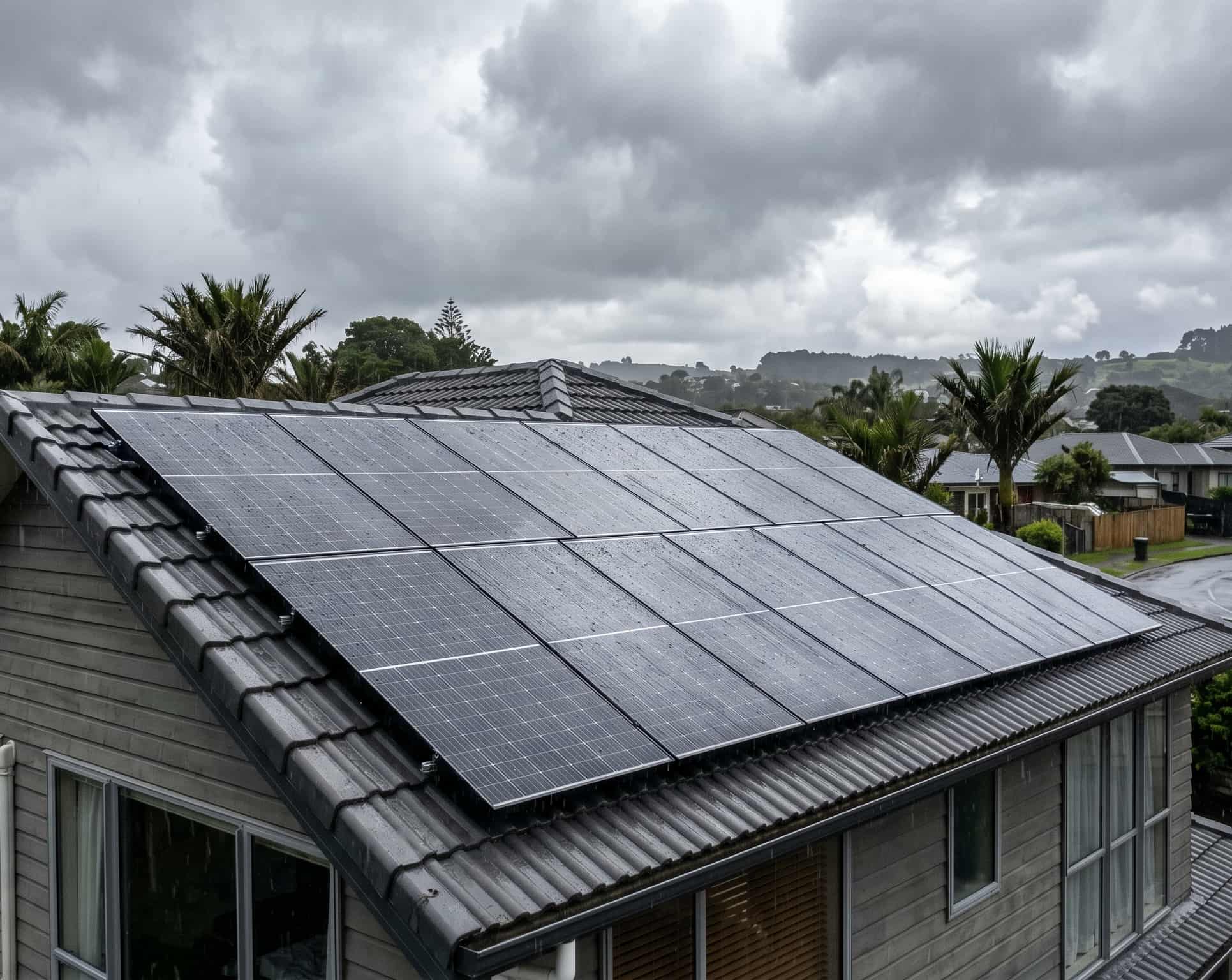
Most Auckland homeowners were told at installation that rain would keep their panels clean. That's the most common piece of maintenance advice in the solar industry, and in Auckland's climate, it's wrong.
Rain does wash dust off panel glass. But dust isn't the main problem in Auckland. Biological growth is. Lichen, algae, and the layer of organic matter that settles on panel surfaces in this climate doesn't respond to rainfall. It uses rainfall. Frequent wet-dry cycling is exactly what it needs to establish and spread, and Auckland provides that cycling more than one day in three.
If your panels have never been professionally inspected since installation, this article explains why Auckland's specific conditions mean that matters more here than in most places, and how to work out whether your system is in the window where action is worthwhile.
NIWA's climate normals for Auckland record 137 wet days per year. That's more than one in three days with measurable rainfall. The point isn't that Auckland is unusually wet. It's that the pattern of frequent rain followed by drying, followed by rain again, repeating across the year, is precisely the cycle that lets biological growth establish on panel glass.
Rain wets the surface, the panel dries, and spores land and find the moisture they need in the next rain event. Repeated often enough, the conditions favour organic growth over clean glass. That's different from how dust behaves. Dust settles and rain washes it away. Lichen and algae attach themselves to the glass surface through tiny root-like structures that grip the micro-texture of the panel. Once attached, they don't wash off.
Auckland's winter makes this worse. NIWA's humidity readings for the Owairaka station average 87.7% at 9am through June and July. At that level, panel surfaces stay damp well into each morning. The longer a panel surface stays wet, the longer biological growth has to establish and take hold. That window extends well beyond what the rain frequency alone would suggest.
The practical upshot: frequent Auckland rainfall doesn't protect your panels from organic growth. It contributes to it.
Panel orientation affects more than how much power your system produces. It also determines how long your panels stay wet each morning, and in Auckland's winter, that difference is significant.
In the southern hemisphere, north-facing panels receive direct sun from early morning through to the afternoon and dry out quickly after overnight dew or rain. West-facing panels face away from the morning sun entirely. In winter, Auckland's sun rises in the northeast and tracks low across the north before swinging west later in the day. A west-facing panel sits in shade from sunrise until early afternoon.
Solar path data for Auckland's latitude at a standard 37° tilt confirms this precisely. At midday on the winter solstice, a north-facing panel receives 1.18 kWh/m² of solar energy. A west-facing panel at the same location receives 0.47 kWh/m², a reduction of around 60%. Through the morning, the gap is even larger. West-facing panels receive effectively zero direct solar energy until the sun crosses their face in the early afternoon.
That shading gap, combined with Auckland's 87.7% winter morning humidity, means west-facing panels stay wet for six or more hours longer than north-facing panels on the same property each winter morning. North-facing panels are drying. West-facing panels aren't.
Research from comparable humid temperate climates backs this up: west-facing panels on unserviced systems show earlier and heavier biological growth than north-facing panels on the same property. Auckland's solar geometry and humidity data support the same outcome.
If your panels face west, your maintenance window is likely to arrive earlier than your neighbours with north-facing panels, all else being equal.
By the way — we built a free scorecard that shows how your heat pump, ventilation and solar are performing. Results are usually surprising.
Your property's distance from the water affects how your system ages, and in Auckland's geography, more properties are within that zone than most homeowners realise.
Auckland sits on an isthmus with the Waitemata Harbour to the north and east and the Manukau Harbour to the south and west, plus open coastlines beyond both. At the narrowest point, no residential property is more than about one kilometre from tidal water on either side. Salt aerosols from the ocean travel further than most people assume. The exposure zone extends well inland from the visible waterfront.
Salt air doesn't damage panel glass directly. What it affects over time is the aluminium frames and mounting hardware that hold your system to the roof. Aluminium corrodes in sustained salt air exposure, and mounting hardware deterioration can compromise the physical security of the installation before the panels themselves show any problem.
Research from Hawaii, where residential solar systems have been in operation in a salt air environment for 12 to 15 years, documents consistent hardware deterioration on coastal properties that doesn't show up in output readings until a component actually fails. Auckland's coastal install base is heading toward that same point.
Salt air damage isn't visible from the ground. A professional inspection is the only way to assess whether frames and hardware are holding up as your system ages.
If you're not sure whether this applies to your system, the install data gives you a useful reference point.
Data from the Electricity Authority's EMI database covers Auckland residential solar installations from 2013 through to early 2026. At the end of 2024, Auckland had around 13,100 residential solar installations, growing to over 14,300 by early 2026. Around 6,300 of those, approximately 44% of the current install base, were completed before 2021. Those systems are now five or more years old.
In similar climates overseas, lichen typically starts appearing at around five to seven years on panels that have never been professionally maintained. Auckland's conditions are close enough that the same window applies here. If that timeline holds, a large share of Auckland's residential install base is either already in that window or approaching it.
The 2022 cohort is next: around 2,000 new Auckland installations in that single year. Those systems are now four years old. Without a professional inspection, the owners of those systems have no documented baseline and no way of knowing what's on the glass or how the frames are holding up.
General soiling from dust and pollen causes modest output losses in Auckland's high-rainfall climate. Biological growth is a different category. Lichen creates localised shading over individual cells, generating hotspots that reduce output from the affected area and become progressively harder to remove the longer they're left. You can read more about how that works in the lichen and biological growth article.
Your installer's guidance on maintenance was almost certainly calibrated for a different climate.
Most content circulating in New Zealand on solar panel care, including what appears on installer websites and in manufacturer handover packs, was adapted from markets where dust is the primary soiling problem. Australia's dry inland cities. Parts of Europe and the American southwest. In those markets, the rain-cleans-panels logic is broadly defensible. Dust settles, rain shifts it, the system stays reasonably clean.
Biological growth doesn't work that way. Lichen and algae establish on wet-dry-cycled surfaces and can't be washed off once they've taken hold. No installer's handover pack mentions this, because the problem doesn't appear until five or more years in, well after the installation team has moved on. The industry's handover process simply hasn't kept pace with what the maintenance picture actually looks like for systems that have been running for several years.
No one told you to arrange an inspection. That's the standard industry gap, not a homeowner failure.
For detail on what output loss actually looks like once biological growth is established, the dirty solar panels and output article covers this in full.
A professional solar inspection should cover more than a clean. Here's what to look for when choosing a provider and what a proper visit should involve.
The visit should start with an inverter output reading before anything is touched, so there's a documented baseline of what the system was producing. The inspection itself should cover the panel glass for soiling, biological growth, delamination, and physical damage; the frames and mounting hardware for corrosion and structural integrity; and the cabling, isolators, and junction boxes for deterioration and weathering.
The clean should follow from what the inspection finds, not the other way around. General soiling is handled with a pure water clean. Early-stage biological growth should be treated at the same visit. Heavy lichen requires a separate remediation visit with specialist chemical treatment. DIY removal with household brushes or off-the-shelf products risks scratching the light-transmitting coating on the panel glass and may affect your manufacturer warranty.
After the clean, a second inverter reading should be taken to show whether output has changed. The visit should end with a written condition report, including before and after photographs, recording what was found, what was done, and what needs further attention. That report is how you build a documented service history for your system, and it's what separates a proper inspection from a commodity clean.
For a full breakdown of what each component of an inspection covers and why it matters, the solar panel inspection article has the detail.
For the practical checklist of what to check yourself between professional visits and what a proper visit should include, see the solar panel maintenance checklist.
Maintenance frequency depends on property conditions more than a fixed calendar interval.
Auckland's climate makes the case for annual or biennial professional inspection stronger than international guidance suggests. Coastal locations, properties with significant tree cover nearby, and west or northwest-facing panels are all likely to reach the biological growth window earlier than north-facing panels in sheltered inland settings.
The most useful starting point is install date. If your system was installed before 2021 and has never been professionally inspected, you have no documented baseline. You don't know what's on the glass, what condition the frames and mounts are in, or whether your output is what it should be for a system of that age and orientation. Nobody told you to arrange an inspection. That's the standard industry gap. A professional visit is what closes it.
For a framework on how to think about intervals and long-term care planning for a New Zealand solar system, the solar panel maintenance article covers this in detail.
If you want to know more about what professional solar panel care looks like in practice, thesolar panel cleaning and maintenance in Auckland. covers what's included and how to get started.
If you want to know where your home energy systems actually stand, the Home Energy Health Assessment at assessment.miht.co.nz takes three minutes. It covers solar, heat pumps, and ventilation, and gives you a personalised picture of where your systems sit.
Your solar system was built to deliver output across 25 years. Whether it's actually doing that, in Auckland's specific conditions, depends on whether anyone has looked at it since installation. In this city, for most systems, nobody has. That's not a reason for alarm. It's a reason to find out where yours stands.
By the way — we built a free scorecard that shows how your heat pump, ventilation and solar are performing. Results are usually surprising.
Auckland's weather doesn't reduce solar generation significantly. The city gets 2,060 sunshine hours per year, which makes solar a worthwhile investment. The issue is what happens between sunny periods. Frequent wet-dry cycling across 137 rain days per year creates the conditions for biological growth to establish on panel glass, which reduces output from the affected cells over time. How quickly this develops depends on your panel orientation and how close you are to the coast.
Rain washes dust and loose debris off panel glass. It doesn't remove biological growth. Lichen and algae grip the glass surface through tiny root-like structures, and once attached they don't respond to rainfall. Auckland's pattern of frequent rain followed by drying, repeated more than one day in three, actually creates the moisture conditions that biological growth needs, rather than preventing it.
West-facing panels stay wet significantly longer than north-facing panels through Auckland's winter mornings. Because the sun rises in the northeast in winter and tracks across the north, west-facing panels sit in shade from sunrise until early afternoon. North-facing panels start receiving direct sun early and dry out quickly. Combined with Auckland's winter morning humidity of around 87%, west-facing panels can stay damp for six or more hours after sunrise each day, which extends the period when biological growth can establish.
The honest answer is that you usually can't tell from the ground. Dust and early-stage biological growth are not visible from below, and output loss happens gradually rather than suddenly, so your monitoring app won't show a dramatic drop. The most reliable indicator is age: if your system is five or more years old and has never been professionally inspected, there's a reasonable chance something is on the glass. A professional inspection is the only way to know for certain.
Yes. Auckland's isthmus geography means a large share of the city's housing is within range of marine salt air from the Waitemata or Manukau Harbours or the open coastlines beyond. Salt air accelerates corrosion of the aluminium frames and mounting hardware that hold your system to the roof. This kind of deterioration doesn't show in output readings until a component fails. Research from Hawaii, where coastal solar installations are 12 to 15 years old, documents consistent hardware problems on coastal properties. A professional inspection is the only way to check the physical condition of your system.
Lichen typically appears as dark grey, green, or black patches on the panel glass, often concentrated at the lower edges or in areas where moisture pools. Early-stage lichen can be small and easy to miss from the ground, particularly on a roof with panels at a shallow angle. It tends to be irregular in shape rather than the smooth film that general soiling produces. If you can safely see your panels and notice anything that looks like patchy discolouration that isn't uniform dust, it warrants a professional inspection. You can read more about what lichen does to a solar system in the lichen and biological growth article.