Before you go...
We built a free scorecard that shows how your heat pump, ventilation and solar systems are performing. Results are usually surprising.
Get my score
No thanks
We built a free scorecard that shows how your heat pump, ventilation and solar systems are performing. Results are usually surprising.
No thanksWe built a free scorecard that shows how your heat pump, ventilation and solar systems are performing. Results are usually surprising.
No thanks
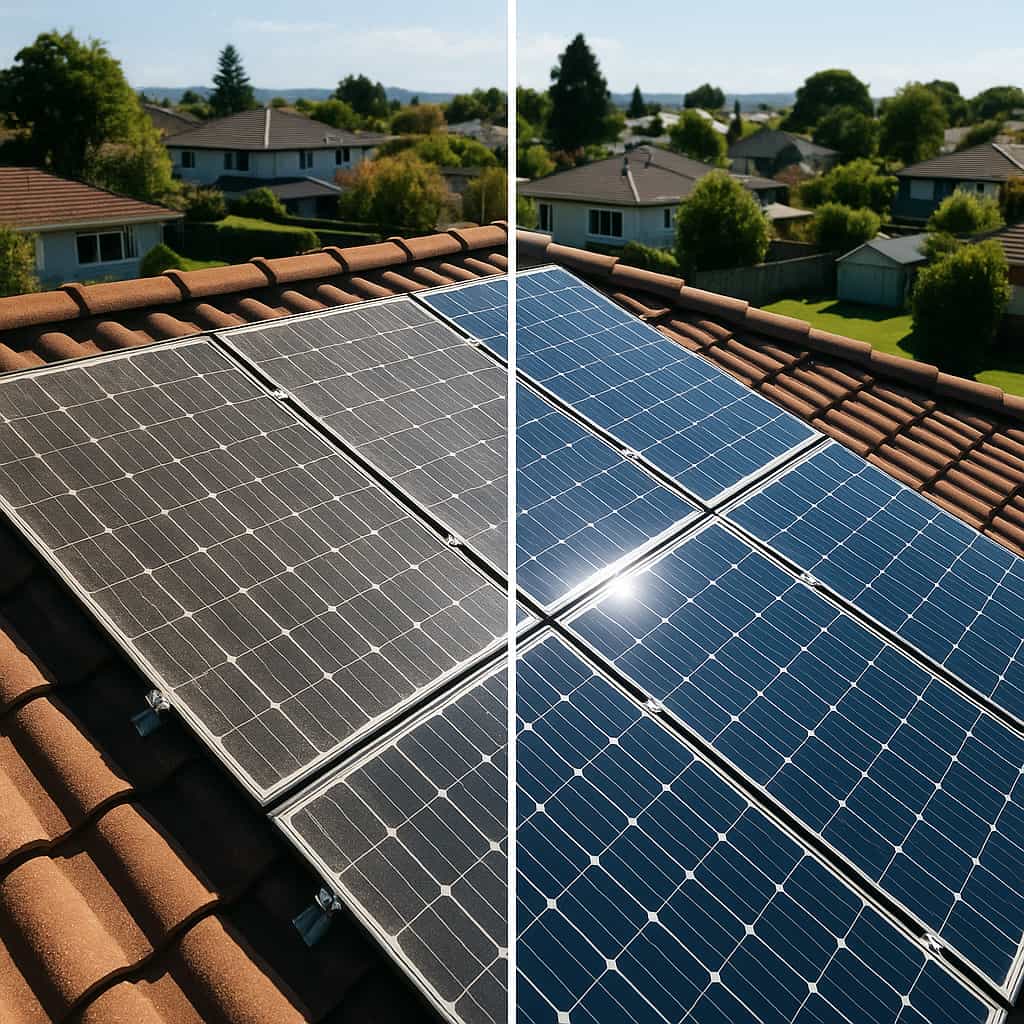
Your solar monitoring app shows you one number: how much power your system produced today. What it doesn't show is how much it should have produced. That gap between actual and potential is where most Auckland solar owners are losing generation without knowing it.
There's no single answer, and anyone who gives you one is oversimplifying.
How much your output drops depends on what's on the panels, how much of it there is, which panels are affected, how long it's been there, and how your roof is oriented. A light film of dust across a north-facing roof at a good pitch in a rainy suburb is a different problem from lichen growing across a flat west-facing array that hasn't been touched in four years.
General dust and pollen typically cost a few percent of output. A concentrated patch of bird droppings or lichen sitting over the cells that generate power produces output loss that is disproportionate to the physical area covered. Hard shading from lichen forces the affected cells to consume power rather than generate it. The deposit itself might look minor from the ground. What it is doing to that section of the array is not.
If your panels have never been cleaned and you've had them for five years, you're almost certainly generating less than you should be. How much less depends on your specific situation, but the loss is real and it builds gradually.
The main problem in Auckland is biological growth, not just dust. Lichen is the one technicians see most often, and west-facing panels tend to accumulate it faster. They stay damp longer into the morning, which gives growth more time to establish. It's a consistent field observation rather than a hard rule, but it comes up regularly on Auckland rooftops. For a full explanation of what lichen physically does to a panel and why Auckland's climate makes it the primary solar threat, see lichen, moss, and biological growth on solar panels.
Bird droppings vary by property depending on what birds are nesting or perching nearby. If birds have established themselves under the panels, the problem goes beyond surface contamination: see birds nesting under solar panels in NZ for what the damage looks like and the right sequence of steps. Coastal homes deal with sea spray that builds up on the glass and accelerates corrosion on the metal frames over time. Near trees, pollen builds up on the glass surface and combines with moisture to form a sticky film that rain doesn't shift. In active development areas across Auckland, construction dust is increasingly common on panels that haven't been touched in a while.
Each leaves a different residue on the glass. Most of it doesn't rinse off cleanly.
Not reliably. A heavy downpour shifts loose dust and reduces surface build-up, but it can't remove the film that develops from airborne grime and organic growth over time. Lichen and bird droppings are unaffected by rain regardless of how much falls.
Panels that haven't been washed still show a visible film after rain. Auckland's wet winters don't substitute for cleaning.
By the way — we built a free scorecard that shows how your heat pump, ventilation and solar are performing. Results are usually surprising.
Dust mixed with moisture can bake onto the glass and form a layer that doesn't respond to rinsing. That's the baseline long-term problem from simple neglect.
Lichen is more serious. Once it establishes, it bonds to the glass and becomes progressively harder to remove. It creates localised shading over individual cells, generating hotspots that reduce output from the affected area. The longer it is left, the more firmly it grips and the more cells it covers.
Bird droppings cause a different problem. A deposit sitting over the same cells for a long time creates concentrated heat in those cells — a hotspot that reduces output from that part of the array. They are also acidic and bond to the glass, so they do not shift without intervention.
The longer panels go without any cleaning, the more likely it is that you're dealing with something that goes beyond output loss.
Your inverter records what your system produced. It doesn't tell you what it should have produced given the weather conditions that day. The decline from dirty panels happens slowly over months or years, so it reads as normal variation rather than a growing problem.
The loss only becomes visible when you compare current output against historical data from when the panels were first installed or last cleaned. Most people don't go looking for that comparison, so the shortfall grows quietly in the background. For a full list of the signs that something may be off — including what to check from the ground — see signs your solar panels aren't performing at their best.
Regular DIY cleaning keeps light contamination from establishing, and it's a reasonable approach if you can reach your panels safely from the ground. For the correct method, tools, and the point where DIY stops being safe, see how to clean solar panels in NZ .Left unattended for twelve to twenty-four months, though, the clean that follows is a different job. Grime and organic growth bake onto the glass, and at that point a Solar System Care Visit is the more reliable way back to full output.
A professional clean uses purified or deionised water where appropriate. Auckland's water supply is relatively soft, so mineral residue from tap water is modest, but a proper finish, whether from purified water or a squeegee, avoids leaving anything behind on the glass.
A good service also includes a visual inspection of the mounting hardware, cabling and isolators, and an inverter reading before and after the clean to record the actual output difference. Every professional visit should produce a written solar panel condition report covering every component; not just the glass. For a full breakdown of what that covers, see what a professional solar panel service includes.
If you're managing it yourself, every few months with a soft-bristle brush is the right rhythm. Do it consistently and you'll likely never see a dramatic drop in output.
If you're leaving it to a professional, every twelve to twenty-four months is a reasonable guide for most Auckland homes. Low-pitch roofs, coastal properties, and homes with heavy bird activity or lichen should be serviced every six to twelve months.
What matters most is not letting years pass without any attention. Someone who has had panels for five years and never cleaned them is almost certainly generating less than they should be. A professional service at that point recovers the output, but the clean takes longer and requires more effort because the grime has had time to bond to the glass.
Between cleans, a quick visual check from the ground is a useful habit. Visible bird droppings, a grey film across the surface, or any sign of lichen are signals to act before the next scheduled clean.
Concentrated build-up from bird droppings or lichen produces output loss that is disproportionate to how much of the panel surface they cover, because hard shading forces individual cells to consume power rather than generate it.
Rain reduces loose dust but doesn't clean panels. A film of airborne grime and organic growth builds up over time and doesn't respond to rainfall alone. Lichen and concentrated bird droppings are not shifted by rain regardless of how much falls.
It depends on your approach. If you're cleaning them yourself from the ground with a soft-bristle brush, every few months keeps growth from establishing and makes each clean quick. If you're using a professional service, every twelve to twenty-four months is a reasonable guide for most Auckland homes. Low-pitch roofs, coastal properties, and homes with heavy bird activity or lichen should be serviced every six to twelve months. The longer panels go without any cleaning, the more work is required to remove what's built up.