Before you go...
We built a free scorecard that shows how your heat pump, ventilation and solar systems are performing. Results are usually surprising.
Get my score
No thanks
We built a free scorecard that shows how your heat pump, ventilation and solar systems are performing. Results are usually surprising.
No thanksWe built a free scorecard that shows how your heat pump, ventilation and solar systems are performing. Results are usually surprising.
No thanks
If you have noticed something growing on your solar panels and searched for what to do about it, you have probably found advice that does not quite fit. Most of the information available was written for dry climates where dust is the problem. Auckland is not that.
Biological growth on solar panels in NZ, including lichen, is common, it gets worse over time, and the methods that deal with dust do not deal with it. Understanding what type of growth you have and what it is actually doing to your panels is the starting point for making a sensible decision.
Not all biological growth behaves the same way, and the difference matters for how it gets treated.
Algae is the first coloniser. It appears as a thin green or brownish film, often streaking from where moisture runs off the roof. It establishes quickly on unclean surfaces and looks worse after rain. On its own, algae is the most straightforward of the three to treat, and the most important to catch early.
Moss grows in thicker, cushion-like clumps, usually in the corners and edges of panels where debris and moisture collect. It holds water against the panel surface, which accelerates degradation of the frame seals over time.
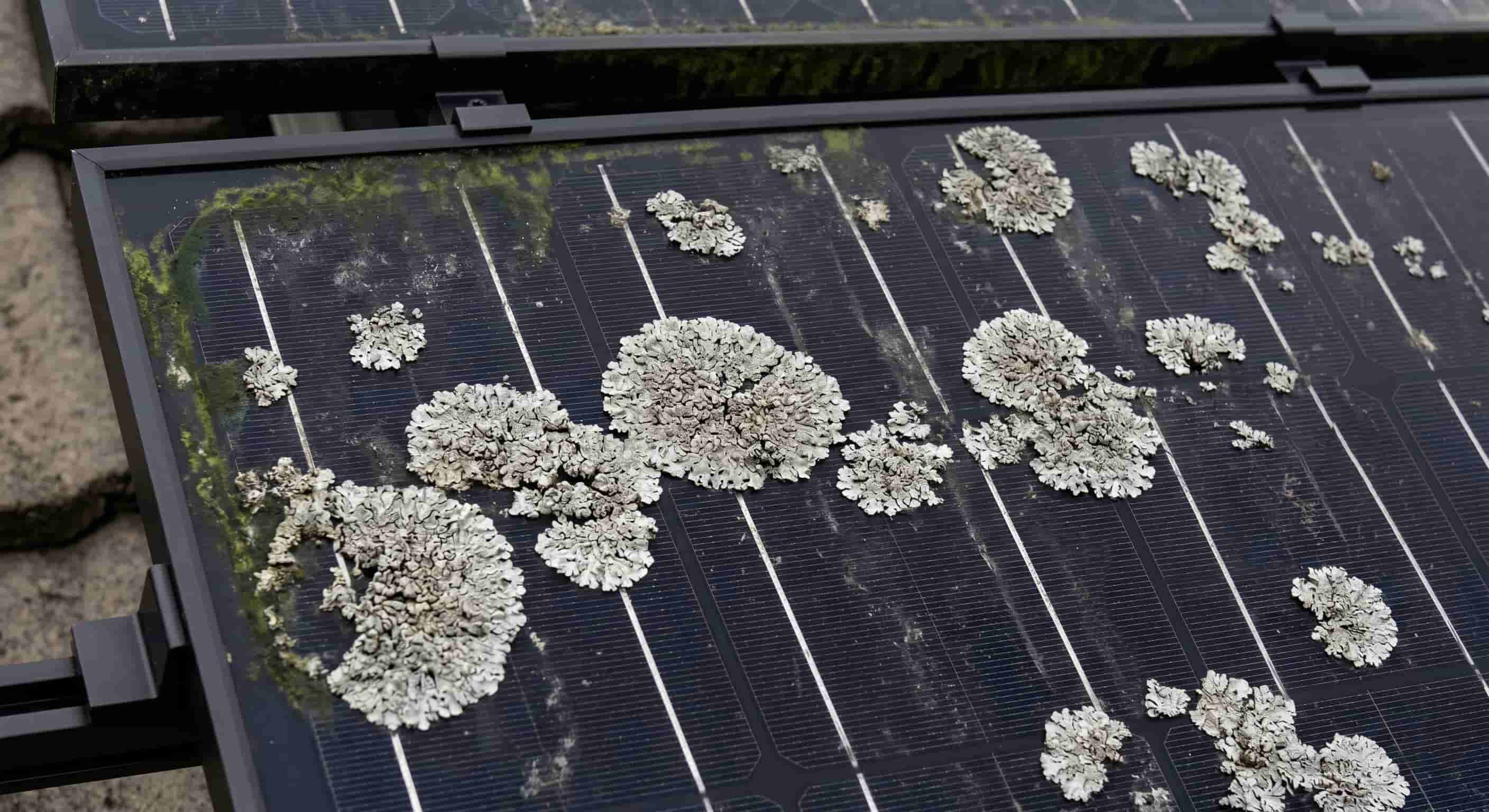
Lichen is the most serious of the three. It appears as pale grey or whitish patches that do not wash off in rain and do not change with the weather. Lichen is a composite organism, part fungus and part algae, that forms an actual physical and chemical bond with the glass surface. Rain does not remove it. A standard clean does not remove it. It requires a different approach entirely.
Most of the advice circulating online about solar panel maintenance was written for arid and semi-arid climates: California, the Middle East, inland Australia. In those environments, dust is the dominant threat. It settles on panels, blocks light, and washes off in rain or with a basic clean.
Auckland and the upper North Island are a different environment entirely. The climate is humid and temperate. Biological growth thrives in these conditions. Dust is rarely the issue here. Lichen, moss, and algae are.
The frequency recommendations, the DIY methods, and the output figures that circulate internationally are calibrated for conditions that do not exist in NZ. If you have been following overseas solar cleaning advice, there is a reasonable chance it has been addressing the wrong problem.
Biological growth does not establish equally on every solar installation. Understanding the conditions that favour it helps you assess your own situation honestly.
West-facing panels are consistently higher risk than north or east-facing panels. They retain moisture longer into the morning because they receive less direct sun in the early hours. More time with a damp surface means more opportunity for algae and lichen to establish between dry periods.
Panels with surrounding vegetation are higher risk. Overhanging trees drop organic material onto the glass, which accelerates biological colonisation. Panels in leaf fall zones, or shaded for part of the day by neighbouring rooflines or trees, tend to show biological growth earlier than panels in open, fully sun-exposed positions.
Coastal properties face additional pressure from salt-laden air. Salt aerosols are hygroscopic, meaning they attract and hold moisture, and they create a surface layer on the glass that traps organic debris and spores, giving biological growth an easier foothold than on inland properties.
Newer panels with an intact anti-reflective coating are more resistant to initial biological establishment than older panels where the coating has experienced some wear. An undamaged coating provides fewer anchor points for algae to take hold.
Panels in sunnier, drier parts of NZ, and north-facing panels on well-exposed roofs, are lower risk. If your panels are north-facing, fully exposed, and in an area without significant surrounding vegetation, biological growth may be a minor consideration. If your panels are west-facing, in a humid area, with tree cover nearby, it is worth checking for growth sooner rather than later.
By the way — we built a free scorecard that shows how your heat pump, ventilation and solar are performing. Results are usually surprising.
Understanding why lichen is treated seriously comes down to understanding what it physically does to the panel surface once it establishes.
Lichen attaches using root-like structures called rhizines, which are fungal filaments that extend from the underside of the growth and anchor into the microscopic texture of the anti-reflective coating surface. This means lichen is not sitting on the panel. It is attached to it.
At the same time, lichen secretes organic acids as part of its biological activity. These acids etch the anti-reflective coating over time and, in more advanced cases, reach the panel seals.
The damage follows a sequence. Lichen creates hard shading over the cells it covers. Unlike soft shading from a passing cloud, which affects the whole array evenly, hard shading blocks specific individual cells entirely. A single shaded cell forces the entire string it belongs to underperform. The output loss is disproportionate to the physical area covered.
The shaded cell, unable to produce power, is forced by the electrical circuit to consume power instead. This generates intense localised heat in the affected cell, known as a hotspot. Sustained hotspot formation causes physical damage to the cell itself. The glass can develop micro-cracks. The EVA encapsulant material that holds cells in place can begin to delaminate. The panel's backing layer can blister in severe cases.
As lichen extends to the frame edges and the silicone seals, biological growth and persistent moisture together work to degrade and physically breach the seal. Once moisture enters the panel through a compromised seal, electrical faults become possible and the rate of degradation accelerates sharply. At the most severe end, panels that have been left unmaintained for many years with heavy lichen coverage can reach a point where cleaning is no longer the question and panel replacement is the only option.
Lichen that has been established for two years behaves very differently from lichen that has been established for six or more years. The older the growth, the deeper the rhizines have penetrated the coating surface. The deeper the penetration, the more the organism has physically become part of the surface rather than simply attached to it. Years of acid secretion have done more etching. The growth itself becomes denser, harder, and more resistant to treatment.
A panel with two years of lichen growth will typically respond to a single treatment cycle. A panel with five or more years of growth may require two full cycles and may still need a follow-up visit. A panel with a decade of unmaintained growth may have areas where the lichen has bonded so thoroughly that aggressive removal risks scratching the glass, and the underlying anti-reflective coating has already been damaged by acid secretion.
The practical consequence is that a system left for eight years is a categorically different job from a system with recent growth. The cost, the time, and in some cases the outcome are all different. Setting those expectations before the job begins, rather than discovering the extent of the problem on the roof, is the honest approach. If your system has never had a professional visit, solar panels that have never been professionally serviced covers what a first visit typically finds and what output recovery looks like.
The extent of lichen growth on a panel is consistently harder to judge from ground level than it appears. The low angle of viewing, the flat profile of the growth, and the fact that lichen can be well-established on cell surfaces before it develops the obvious crusty grey appearance all mean that a close inspection on the roof frequently reveals more than the initial ground assessment suggested.
Growth that appears to be a small patch from below often covers a much larger area when seen from directly above. Early-stage lichen on a cell surface may be difficult to see at all from the ground. This is one reason the inspection component of a professional solar care visit matters. It is the part that establishes what is actually there.
The instinct to deal with something yourself is reasonable. Solar panels are accessible, the growth is visible, and it seems like the kind of problem that should yield to a brush and some cleaner.
The difficulty is that the methods most people reach for can cause permanent damage.
Scrapers and stiff brushes scratch the anti-reflective coating on the panel glass. The coating is what allows panels to capture maximum light. Once scratched, it cannot be restored and the output reduction is permanent for the life of the panel.
Off-the-shelf cleaning products, including bleach-based cleaners and general-purpose biocides, are not formulated for solar panel surfaces. Many are not compatible with the silicone seals or the aluminium frame. Applying the wrong product risks voiding the manufacturer's warranty, and the damage may not be immediately visible. It can show up later as discolouration, delamination, or seal failure.
Your panel manufacturer's warranty typically specifies that maintenance must be carried out using approved methods and products. A DIY attempt that uses incompatible materials gives the manufacturer grounds to decline a warranty claim on any subsequent fault. For more on what a professional solar panel cleaning service should include, and why the method matters, that article covers the key questions to ask any provider before you book.
Many NZ homes collect rainwater from their roofs for drinking water. This is a specific consideration when biological growth treatment is involved.
Any biocide applied to solar panels will run off in the next rainfall. If that runoff enters a tank used for drinking water, it is a genuine public health risk. This is not an edge case. It is a real consideration for a significant number of NZ households.
Professional treatment of biological growth on panels at a property with roof water collection requires a documented protocol: the water tank must be disconnected before any chemical treatment is applied, and the roof must be thoroughly rinsed before reconnection. This requires planning before the job begins, not as an afterthought on the day.
If your home collects drinking water from the roof, confirm that any company you engage for biological growth treatment has a clear protocol for this before they arrive
.
A standard solar clean with pure water and a soft brush does not remove established lichen. The anchoring mechanism means the growth cannot be lifted from the surface without first breaking the bond.
Professional treatment follows a specific sequence. An approved biocide, formulated for use on solar panel surfaces, is applied to the affected areas and left to soak. The soak period is what does the work: it breaks down the organism's hold on the coating so the growth can be removed without mechanical force that would cause further damage.
After the soak, the loosened growth is removed using a specialist cleaning solution and techniques appropriate for the panel surface. The panel is then rinsed with pure water to ensure no mineral residue is left on the treated surface.
This process uses different products, requires adequate soak time, and demands knowledge of what is safe to apply to panel glass and seals. It takes longer and costs more than a standard clean. In cases where lichen has been established for many years, a single treatment cycle may not achieve full removal. Some panels may require a follow-up visit. In severe cases, where lichen has caused irreversible damage to the seals or glass, cleaning alone cannot fully restore the panels.
The inspection comes first. The clean follows from what the inspection finds. A condition report documents what was found and what was done. Anything outside the scope of cleaning and maintenance is referred to the relevant specialist. A visit that skips the inspection step cannot tell you what your system actually needs.
Removing established lichen addresses what is present at the time of the job. It does not change the underlying conditions that allowed it to establish.
If a panel retains moisture longer than it should because of its orientation or surrounding vegetation, and if the surface is left without ongoing maintenance after treatment, algae will re-establish and the pathway to lichen begins again. In favourable conditions, the cycle from a treated surface back to visible lichen can occur within a few years.
This is the practical argument for ongoing professional maintenance rather than a one-off treatment. Treatment is the reset. Maintenance is what keeps the surface from reaching that point again. The two are not interchangeable.
Lichen does not appear on well-maintained panels. This is how the biology works.
Lichen establishes through a pathway that begins with algae. Algae is the first organism to colonise an unclean panel surface. Once algae is present, it creates the surface conditions and organic matter that allow lichen to establish.
The prevention window is the window before algae becomes established. A professional care visit that includes appropriate biocide treatment of developing biological growth kills algae before lichen can follow. The panel never reaches the stage where lichen remediation is needed.
Panels on a regular professional maintenance schedule are extremely unlikely to develop lichen. Panels left without attention long enough for algae to establish will, in Auckland's climate, progress to lichen. The difference between the two outcomes is not luck or geography. It is timing.
The MiHT Care Plan is the mechanism that keeps your panels on the right side of that threshold. The cost of annual maintenance is a fraction of the cost of lichen remediation, and a smaller fraction again of the cost of panel replacement in a case where lichen has been left too long.
By the way — we built a free scorecard that shows how your heat pump, ventilation and solar are performing. Results are usually surprising.
Rain does not remove established biological growth. Algae can be partially rinsed off by heavy rain but re-establishes quickly. Lichen is physically bonded to the panel surface and is not affected by rainfall. The only reliable way to remove established lichen is chemical pre-treatment followed by specialist removal by a solar maintenance profession with the correct products and equipment.
Dirt and dust tend to be brown or grey-brown, distributed across the surface, and will at least partially wash off in rain. Lichen appears as pale grey, whitish, or greenish flat patches that remain after rain and do not move or change with weather. It often has a slightly crusty or roughened texture. If growth is still there after several rainfalls, it is almost certainly biological.
In most cases yes, provided the growth is identified and treated before it has been established for many years. Lichen that has been left for a long time, particularly five years or more, may have caused some permanent damage to the anti-reflective coating or panel seals. In those cases, professional treatment will remove the growth, but the underlying damage may not be fully reversible. In severe cases, panel replacement may be the only option.
Lichen itself does not void a warranty. Attempting to remove it using incorrect methods or products can. Most panel manufacturers specify that maintenance must use approved materials and methods. A DIY removal attempt using a scraper, stiff brush, or incompatible chemical gives the manufacturer grounds to decline a warranty claim on any subsequent fault. Records of professional maintenance visits are the most straightforward protection.
Annual professional maintenance is the recommended frequency for panels in Auckland and the upper North Island. The humidity and temperature in this region create conditions where biological growth can establish relatively quickly on an unclean surface. An annual visit that includes inspection, biological growth treatment at the algae stage, and a thorough clean is the most reliable way to prevent lichen from establishing.
A hotspot occurs when one cell in a panel is shaded while surrounding cells are generating power. The shaded cell stops contributing and begins consuming energy from the rest of the array, heating up as a result. Sustained hotspot formation causes progressive cell damage. Lichen creates hard shading over specific cells, which is why it is a direct cause of hotspot formation. Left unaddressed, hotspots shorten the life of the affected panel.