Before you go...
We built a free scorecard that shows how your heat pump, ventilation and solar systems are performing. Results are usually surprising.
Get my score
No thanks
We built a free scorecard that shows how your heat pump, ventilation and solar systems are performing. Results are usually surprising.
No thanksWe built a free scorecard that shows how your heat pump, ventilation and solar systems are performing. Results are usually surprising.
No thanks
A room that takes longer to heat than it used to. A unit you barely use that smells off when you turn it on. A musty smell that comes back a week after you clean the filters.
In a multi-split, these problems usually share the same root cause.
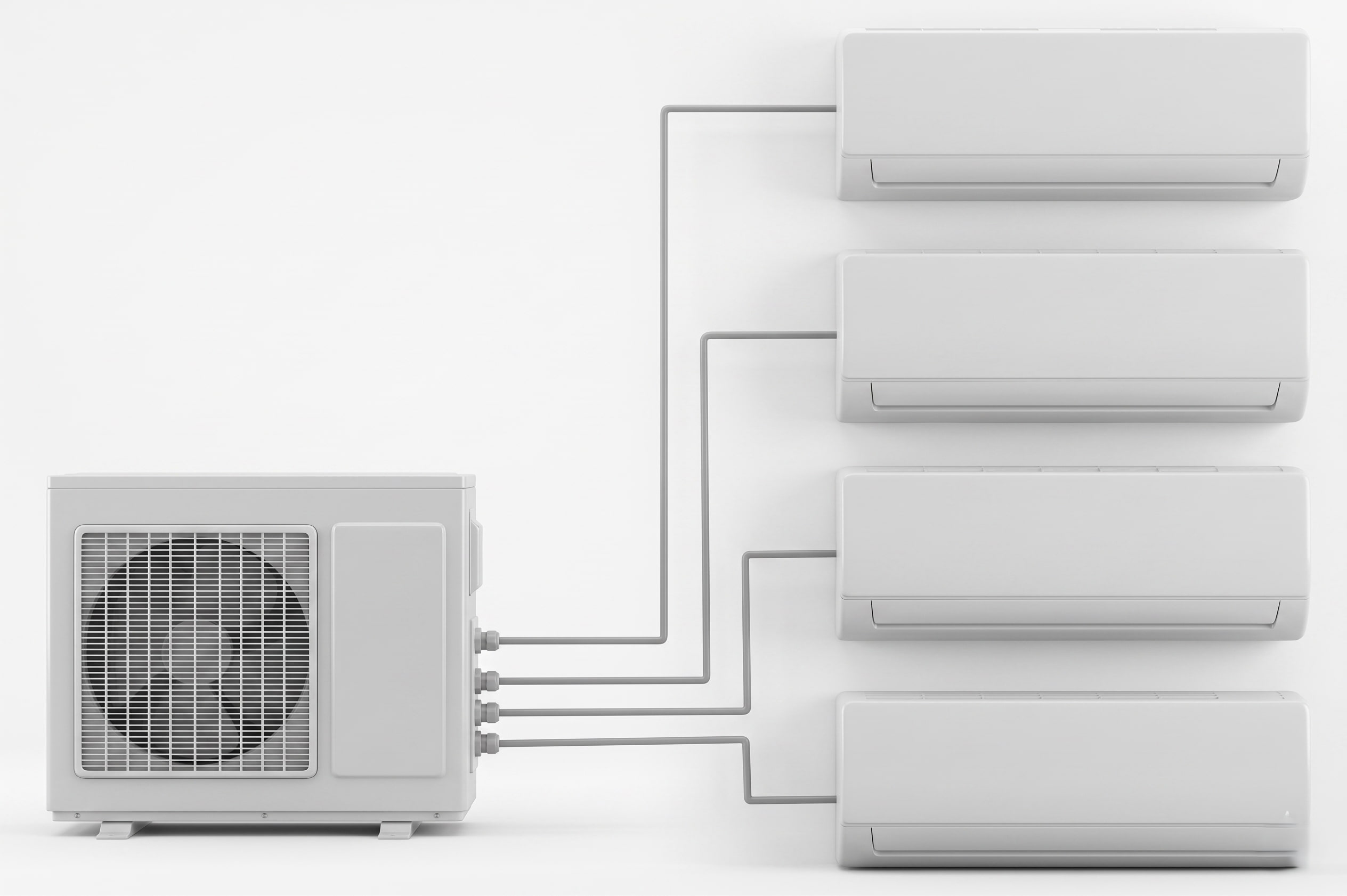
A single compressor and refrigerant circuit serves every indoor unit in the house; two, three, sometimes four of them. Each indoor unit has its own filter, internal coil, internal fan and drain line carrying moisture away to an external outlet.
The rooms run independently. You set different temperatures in different rooms. The outdoor unit adjusts to match whatever the indoor units are asking of it.
Sharing one outdoor unit is what makes a multi-split different from a row of single-split systems. With single splits, each outdoor unit answers to exactly one room. A problem in one doesn't reach the others. With a multi-split, every indoor unit is connected to the same compressor.
Your lounge unit probably runs most of the year. Bedroom units run most nights. A guest bedroom unit might run a handful of times.
The units in worst condition when a technician arrives aren't always the most-used ones.
A unit that runs frequently has a chance to dry out between cycles. The internal fan pushes air through the internal coil and carries moisture away. A unit that runs infrequently doesn't get that opportunity. Short, occasional cycles can leave the internal coil and internal fan damp for long stretches. That's where mould builds up fastest.
The guest bedroom unit that "barely gets used" can be the dirtiest unit on the system. It's often the last one you would suspect, and the first one that surprises a technician.
Which side of the house a room is on also plays a role. Rooms that get hotter in summer or colder in winter get more use, and the units serving those rooms accumulate buildup faster. One unit can be heavily blocked while another on the same system, installed the same day, is almost clean.
When one indoor unit is restricted by buildup on the internal coil and filter, the outdoor unit has to compensate. It runs longer and pushes harder to maintain set temperatures across the whole system. That strain doesn't stay in the room with the dirty unit. It runs through the compressor every other room depends on.
You pay for this efficiency loss every time the system runs, even if you can't spot it on your power bill. That's The Set and Forget Cost at work.
Understanding what happens inside a heat pump when it isn't serviced explains the compressor wear side of this — the mechanism that turns a dirty unit into a shortened lifespan.
The outdoor unit on a multi-split is also physically larger than a standard single-split unit. It handles more refrigerant flow and serves more rooms. The cleaning process is the same as on any outdoor unit. The consequences of skipping it are proportionally larger, because every room in the system depends on it running cleanly.
A full multi-split service typically takes two to three hours, depending on the number of indoor units. There's a specific sequence a proper job should follow, and the reason for it matters.
Before any cleaning begins, a technician should take a delta-T reading on each indoor unit. Delta-T is the temperature difference between the air being drawn in and the air coming out. It measures how efficiently heat transfer is actually happening. Recording it first establishes the baseline; what each unit is doing right now, before any work is done.
Each indoor unit should then be cleaned individually. That means the filter, the internal coil, the internal fan, the drain tray, drain line and all accessible internal surfaces. Where a layer of organic growth is present on the internal coil or internal fan, specialist cleaning solution should be used to break it down properly. The drain line should be cleared and confirmed flowing.
The outdoor unit follows. The condenser coil, the fan and the clearance around the unit all need to be cleaned and checked. A dirty condenser coil forces the compressor to work harder on every cycle; and on a multi-split, that affects every room simultaneously.
Once the outdoor unit is done, a second round of delta-T measurements should be taken on each indoor unit. Those post-clean readings confirm whether the service actually restored heat transfer. If the numbers haven't moved, something wasn't done properly.
A condition report should document the findings for every unit, with the outdoor unit covered separately. Each indoor unit should have its own entry: what was found, what was done, what the before and after readings showed.
A system where all units share the same service history will often show completely different conditions room by room when a technician opens it. The spare room unit might be almost clean while the lounge unit is heavily blocked; even when both were last serviced at the same time.
You might wonder if you can service just some of your indoor units. Partial servicing doesn't give a complete picture of the system.
Each indoor unit contributes to the load on the shared outdoor unit. Servicing two out of three units leaves a dirty internal coil in the third still restricting airflow and adding load to the compressor. The condition report is also incomplete: you're documenting the state of two rooms but not the third.
There's a more practical reason too. The unit that looks fine, or that "barely gets used," is often the one in worst condition when the technician opens it. Leaving it out because it doesn't seem like a priority is exactly when it tends to be the one that needs the most work.
The indoor air quality risk is real. The room you pay least attention to is often where mould has had the most time to develop undisturbed. That mould is in the air every time the unit runs, regardless of how infrequently that is.
The maintenance tasks between professional services are the same as on a single-split system, multiplied by the number of indoor units.
Each indoor unit has its own filter. Clean all of them every three to four weeks. Skipping the filters on the rooms used least is a common pattern, and those are the units where restriction tends to develop unnoticed.
Keep the outdoor unit clear of debris, vegetation and any growth on the casing. Hose it down whenever it looks dirty. The clearance around the unit matters for airflow.
Cleaning the filters yourself addresses the surface layer. The buildup on the internal coil and internal fan behind the filter is a separate issue, and that's what professional servicing is for.For the correct process across each indoor unit, see how to clean heat pump filters.
Once every one to two years, depending on usage and how the indoor units are being used across the system.
For a system where all indoor units run regularly, and particularly where any unit runs in cooling mode through summer, annual servicing is the right interval. The cooling cycle generates moisture inside the unit, which creates the conditions for mould to develop on the internal coil and internal fan.
Where cooling is minimal and you clean the filters consistently, a two-year interval is reasonable. Your first condition report shows how fast your system actually gets dirty, which makes it straightforward to know when to book the next one.
If a multi-split system has never had a professional multi-split service, a full Restore is the right starting point. The indoor units on an unserviced system are rarely in the state you'd expect.
A technician can clean them one at a time, but you only get the full picture of your system's health when a single visit covers everything. All indoor units share one compressor. Servicing some but not others leaves dirty internal coils still adding load to that compressor, and leaves your condition report incomplete. A partial service is also likely to miss the unit in worst condition, which is often the one used least.
A full service typically takes two to three hours, depending on the number of indoor units. That's longer than a single-split service because every indoor unit requires the full cleaning process, and the job should include delta-T measurements across all units before and after the clean to confirm performance has been restored.
A unit that runs frequently has repeated airflow cycles that carry moisture away from the internal coil and internal fan. A unit that runs infrequently doesn't get that opportunity. Occasional, short cycles can leave the internal components damp for long periods, which is where mould develops fastest. The unit nobody thinks about is often the one that needs the most work when the technician opens it.
The cleaning process is the same, but the consequences of skipping it are much worse. A dirty condenser coil on a single-split outdoor unit affects one room. The same problem on a multi-split outdoor unit affects every room the system serves.
Both use one outdoor unit to serve multiple parts of the home. A multi-split has visible indoor units mounted on walls or floors in each room, each with its own controls. A ducted system has a central air handler hidden in the ceiling or under the floor, delivering conditioned air through ceiling vents. Servicing a ducted system involves getting into the roof cavity or subfloor to inspect ductwork and drain runs.