Before you go...
We built a free scorecard that shows how your heat pump, ventilation and solar systems are performing. Results are usually surprising.
Get my score
No thanks
We built a free scorecard that shows how your heat pump, ventilation and solar systems are performing. Results are usually surprising.
No thanksWe built a free scorecard that shows how your heat pump, ventilation and solar systems are performing. Results are usually surprising.
No thanks
For most Auckland homes, a heat pump needs professional servicing at least once a year. How often beyond that depends on where the unit is installed, how heavily it is used, and the environment it operates in. Here is how to work out where your system sits.
Please note: this article covers wall mounted and floor mounted heat pump units. If you have a ducted heat pump system, see our ducted heat pump servicing guide. If you have a multi-split system, see our multi-split heat pump servicing guide.
Most Auckland homes need a professional service at least once a year. Systems with heavy year-round use, coastal exposure, or floor console units in carpeted rooms typically need attention every six months. Light-use systems in clean environments can sometimes stretch to every two years, though annual servicing is the safer baseline.
Auckland heat pumps generally need more attention than those in drier parts of New Zealand, and the reason is in how they are used.
A 2025 University of Otago study on residential cooling behaviour in New Zealand found that 65% of households surveyed had a heat pump, and 72% of those used it for cooling. That means close to half of all homes in the survey were running their heat pump as an air conditioner through summer. The researchers described this as an energy transition that was not anticipated when heat pumps were first installed in New Zealand homes, most were purchased for winter heating and have since become the primary cooling tool as well.
Auckland sits at the warmer end of that pattern. Research data shows the proportion of abnormally hot days in Auckland grew from around 5% in the 1960s to over 22% by the 2010s. More hot days means more cooling hours, and more cooling hours means more wear on the system; on both the internal components and the outdoor unit.
When a heat pump runs in cooling mode, it removes moisture from the air. In Auckland's warm, humid summers, the volume of moisture passing through the system is higher than in drier climates. That moisture, combined with warmth, creates the conditions in which mould and bacteria grow inside the unit. The more cooling hours a system clocks up, the faster that biological growth accumulates.
For properties located close to the coast, the outdoor unit faces additional stress from salt-laden air that inland homes do not experience. For those homeowners, the servicing standard is higher still.
A heat pump running most days across both the cooling and heating seasons is accumulating more wear and internal buildup than one switched on only occasionally. For high-use systems running year-round, an annual professional service is the minimum appropriate frequency. Many Auckland homes running their heat pump through both seasons will benefit from a service every six months.
A heat pump used only occasionally, say switched on during the coldest winter nights, may be adequately maintained with a professional service every two years. This scenario is less common in Auckland, where mild winters still prompt regular use and summers are warm enough to drive consistent cooling demand.
Location inside the home makes a real difference to how quickly a system accumulates debris.
A heat pump installed in an open-plan living or dining area that shares airspace with a kitchen draws in cooking particles, grease vapour, and airborne food matter alongside normal dust. These particles coat the internal coil and internal fan faster than dust alone and are harder to remove. Units in open-plan spaces near active kitchens tend to accumulate internal buildup more quickly and benefit from more frequent servicing.
A heat pump in an older home, particularly one with older carpet, exposed timber, or drafty gaps that let in outdoor air, is drawing in more particulate matter than a unit in a modern, well-sealed new build. Older homes in Auckland tend to have higher dust loads, and their heat pumps reflect that.
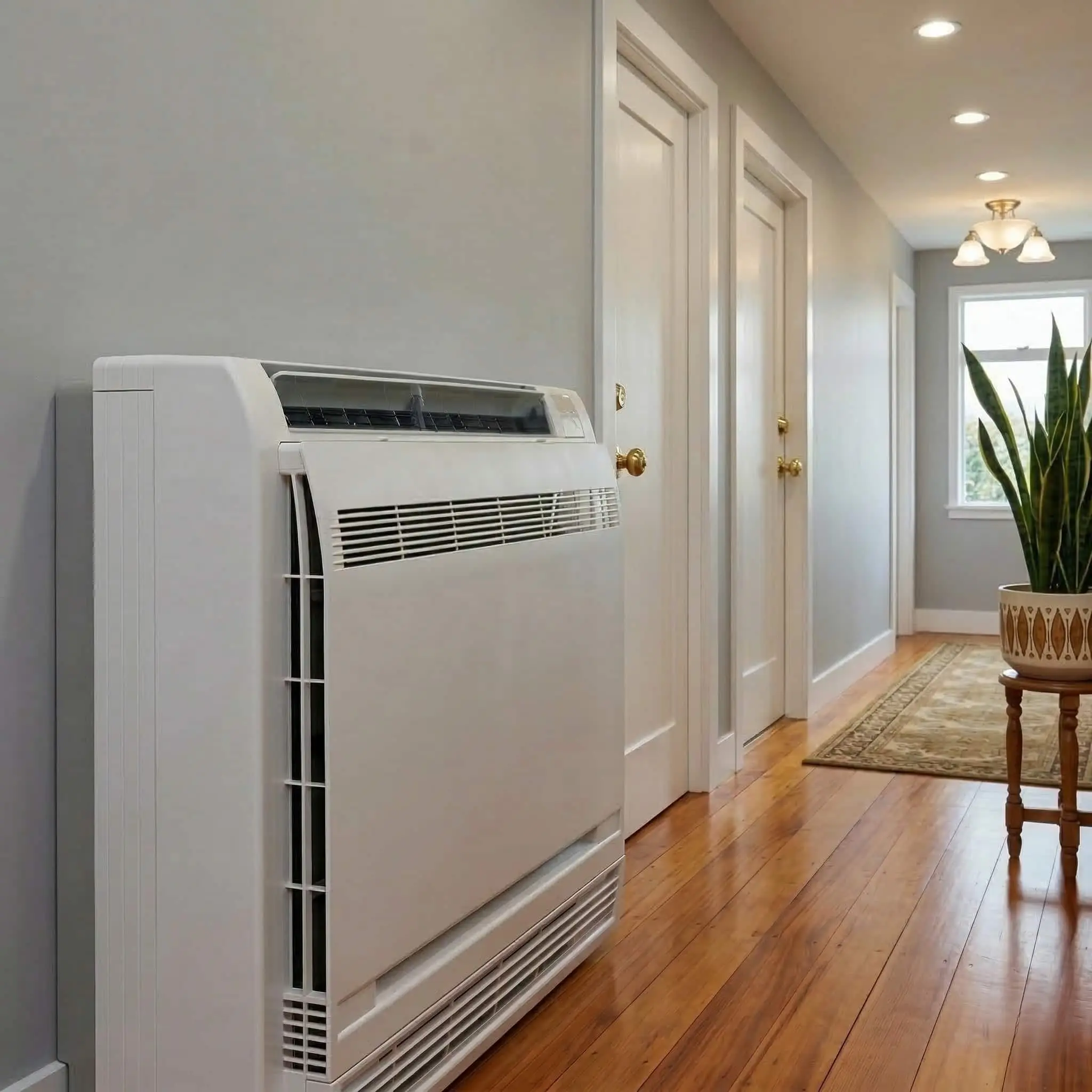
Floor console heat pumps are less common in Auckland than wall mounted units, but they present a specific servicing consideration. Because they draw air in at floor level rather than from height, they pull in carpet fibres, dust, and debris that settles on the floor around them. In carpeted rooms, this increases the rate at which filters and internal components become clogged. Floor mounted units in carpeted rooms should be assessed more frequently than wall mounted units in the same environment, typically every six months rather than annually. For a full guide to what a floor console service involves and how it differs from a wall unit service, see floor console and floor mounted heat pump service in NZ.
For properties close to the coast, the outdoor unit is exposed to salt-laden air that accelerates corrosion of the metal components over time. Mitsubishi Electric NZ notes that systems installed close to the sea may require additional protection and more frequent maintenance, and recommends cleaning the outdoor unit every six months. For coastal properties, professional servicing at that frequency ensures the internal components receive thorough attention at the same time, rather than the owner managing outdoor unit cleaning separately.
Mitsubishi Electric also notes that indoor units in coastal homes can be affected by corrosive air, not just outdoor units, as salt can enter through windows, doors, and ventilation systems. This makes full professional servicing, rather than filter cleaning alone, particularly important for coastal homes.
Filter cleaning is separate from a professional service and needs to happen more often, roughly every four to six weeks for a system in regular use. A clean filter keeps airflow moving but does not reach the internal coil, fan, or drain, which is why professional servicing on the schedule above is still needed. See our heat pump filter cleaning guide for the full process.
Mitsubishi Electric NZ, whose units are New Zealand's most widely installed heat pump brand, recommends cleaning filters with every seasonal change and cleaning the outdoor unit every six months. On their Maintenance and Responsibilities page, they confirm that standard residential systems should be professionally serviced at least annually, and that coastal or geothermal systems warrant more frequent servicing.
Their guidance is clear that regular maintenance removes salt, dust, and contaminants from internal coils and drain trays, prevents moisture buildup that accelerates corrosion, and identifies early signs of wear before they become major problems. Their position is straightforward: a small, regular maintenance effort makes a significant difference over the life of the system.
GENERAL (formerly Fujitsu General) takes the same position, recommending annual professional servicing for all residential units. For brand-specific guidance including Fujitsu's warranty terms, see the guide to Fujitsu heat pump service NZ. Gree is one of the more explicit brands on this point, with the 2026 NZ warranty card requiring annual servicing as a condition of coverage. See the Gree heat pump NZ guide for the detail.
Every six months: systems with heavy year-round use, properties close to the coast, homes with pets, households with occupants who have respiratory conditions or allergies, units in open-plan spaces near active kitchens, and floor console units in carpeted rooms.
Once a year: the appropriate baseline for most Auckland homes running their heat pump through both the heating and cooling seasons. This aligns with the manufacturer's recommendation for standard residential systems.
Every two years: only appropriate for systems with genuinely light, occasional use in clean environments. If you are unsure, annual servicing is the safer starting point.
The most common pattern we see is a heat pump that was installed, used regularly, and never professionally serviced until something went wrong. By that point, years of internal buildup have reduced efficiency, driven up power bills gradually, and in many cases degraded air quality throughout the home without the occupants realising the source.
The cost of that neglect accumulates quietly. A system running at reduced efficiency because of a dirty internal coil costs more to run every single day. That daily cost over two or three unserviced years frequently exceeds the cost of the professional services that would have prevented it. Annual servicing is not a cost. It is the cheaper option.
The Healthy Homes Standards require rental properties to have a qualifying fixed heater capable of heating the main living room to 18 degrees. Most Auckland rental properties meet this through a heat pump. What the standards do not specify is a servicing schedule, but they do require the heating source to be in good working order.
A heat pump that has not been professionally serviced and fails during a tenancy creates a compliance problem. It also creates a tenant complaint and a repair bill that is almost always more expensive than the maintenance that would have prevented it. For landlords managing multiple properties, an annual servicing schedule across the portfolio removes that risk entirely and provides documented proof of maintenance if a dispute ever arises.
An annual care plan removes the need to remember, schedule, or coordinate individual service visits. We contact you when the service is due, handle the booking, and provide a digital report after each visit.
You do not always need to count the months. These are signs your system needs attention regardless of when it was last serviced:
A musty or stale smell when the unit runs. A noticeable drop in heating or cooling performance. The system running constantly without reaching the temperature you have set. A visible layer of dust on the louvres or grilles. Any unusual noise during operation.
If any of these apply, a professional service is overdue.
By the way — we built a free scorecard that shows how your heat pump, ventilation and solar are performing. Results are usually surprising.
For most Auckland homes, an annual professional service is the appropriate minimum. Mitsubishi Electric NZ recommends standard residential systems be professionally serviced at least annually. Homes with heavy year-round use, coastal properties, pets, or occupants with respiratory conditions benefit from a service every six months. Light-use systems in clean environments may be adequately maintained every two years, though annual servicing is the safer baseline.
Yes, in most cases. Auckland's humid summers mean heat pumps running in cooling mode handle higher moisture volumes, accelerating internal mould growth. Properties close to the coast also face additional corrosion risk from salt air on both indoor and outdoor components. Both factors mean Auckland systems, particularly coastal ones, generally require more frequent attention than those in drier, inland locations.
A musty smell, reduced heating or cooling performance, the system running constantly without reaching temperature, or visible dust buildup on the unit are all signs a service is overdue, regardless of how long ago the last service was.
Yes, in most cases. Floor console units draw air in at floor level, which means they pick up more carpet fibres, dust, and debris than wall mounted units. In carpeted rooms, they typically benefit from a service every six months.
A professional annual service covers a full assessment of the system, deep cleaning of the internal coil, internal fan, drain system, and outdoor unit, along with sanitisation, an operational test, and a written service report with before and after photos. See our full guide to what a professional heat pump service includes for a detailed breakdown.
An annual care plan means we schedule and manage your heat pump servicing automatically. You do not need to remember when it is due. We contact you, confirm the visit, carry out the service, and provide a digital report. Portfolio pricing is available for landlords managing multiple properties.
The standards require the heating source to be in good working order. While they do not specify a servicing schedule, a heat pump that has not been maintained and fails during a tenancy creates a compliance issue. Regular servicing provides documented evidence of maintenance and protects against tribunal disputes.