Before you go...
We built a free scorecard that shows how your heat pump, ventilation and solar systems are performing. Results are usually surprising.
Get my score
No thanks
We built a free scorecard that shows how your heat pump, ventilation and solar systems are performing. Results are usually surprising.
No thanksWe built a free scorecard that shows how your heat pump, ventilation and solar systems are performing. Results are usually surprising.
No thanks
Your solar output looks a little lower than it used to. Your power bill has crept up over the past couple of winters. You've put it down to the panels ageing, that's what happens to solar, isn't it? They lose a bit of efficiency each year, the performance graphs show a gradual decline, and that's just the nature of the technology.
Most solar owners never received a service schedule. No one came back after installation to explain what regular maintenance involved, when to book it, or what a professional visit would look like. The installer commissioned the system, handed over a brochure, and left. That's the standard experience, not an unusual one.
That output decline most Auckland homeowners are quietly noticing on their unserviced systems isn't natural ageing. It's something else entirely.
Yes, in most Auckland installations, a system that has never been professionally seen has accumulated years of biological growth, hardware wear, and output loss without any of it being documented or addressed.
The pattern most homeowners experience is the Untapped Power problem in its most common form: a system producing less than it's capable of, with nothing visible to indicate why. The loss accumulates across years, not days. It doesn't announce itself. Each month the shortfall is small enough to attribute to weather or usage. Across five years, the picture is different.
A major panel manufacturer, when contacted by a homeowner who found biological growth on their panels at five years, confirmed their installation manual contained no cleaning guidance. Their advice: the system should have been inspected annually. Nothing in the documentation said so. That exchange is representative of an industry-wide problem. The maintenance obligation wasn't hidden from homeowners. It was simply never communicated.
If your system has never been professionally seen, you weren't negligent. You acted on the information you were given. The problem is that the information was incomplete.
By the way — we built a free scorecard that shows how your heat pump, ventilation and solar are performing. Results are usually surprising.
The global solar cleaning advice circulating online was written for arid climates. In those environments, dust is the dominant problem. It settles, blocks light, and mostly washes off in rain or with a basic clean. Annual output loss from general dust soiling runs at 3 to 5 percent globally. Auckland's high rainfall means panels here stay relatively clean from general soiling, so dust sitting on panel glass is unlikely to be causing a significant problem for most Auckland homeowners.
Algae, moss, and lichen establish on unclean panel surfaces in humid, temperate conditions. They don't wash off. If you've been following international solar maintenance advice, you've been reading about the wrong problem. The dust cleaning schedules, DIY methods, and output figures that circulate from overseas reflect a different climate. In Auckland, biological growth is what does the damage.
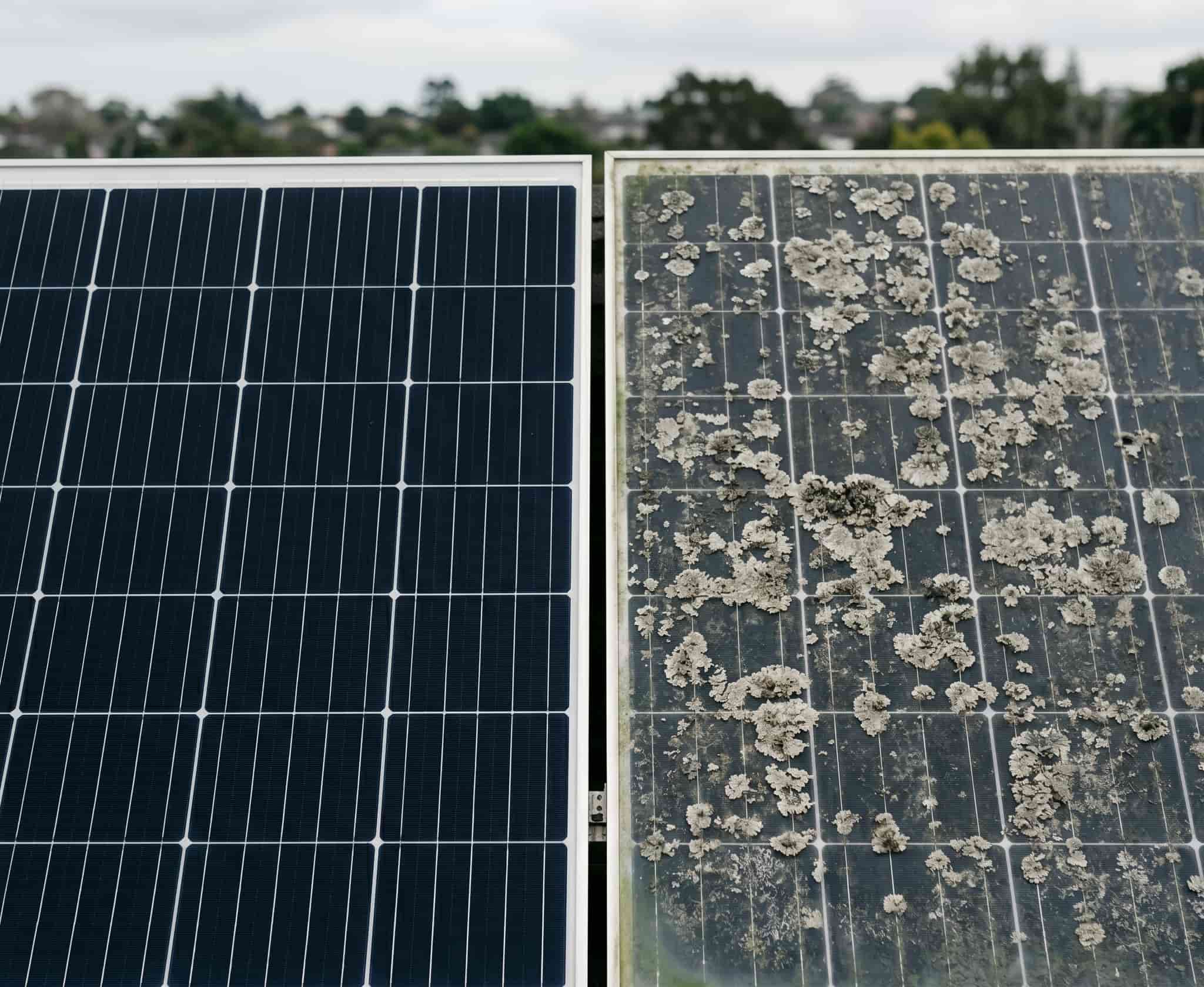
Lichen is the most serious of the three. It isn't dirt. It's a composite organism, part fungus and part algae, that uses root-like structures to anchor physically into the anti-reflective coating and secretes acids that etch the glass surface over time. Once established, it requires chemical pre-treatment, soak time, and specialist removal technique. Rain doesn't remove it. A standard brush-and-water clean doesn't remove it either. For a full breakdown of what lichen does to panel glass and how the damage sequence progresses, the lichen, moss, and biological growth article covers the mechanism in detail.
On a maintained system, algae is caught and removed before it has the chance to develop into lichen. On a system that's never been professionally serviced, that progression from algae to established lichen has been running unchecked since installation.
For an Auckland homeowner with no biological growth present, general soiling is unlikely to be causing a significant problem. Auckland's high rainfall keeps most panels reasonably clean, and the IEA estimates global average soiling losses at 3 to 5 percent annually. NZ conditions typically sit at the lower end of that range.
Lichen and concentrated bird droppings are a different category entirely. They create concentrated shading on specific individual cells, which causes a ripple effect through the whole panel string. A cell that's shaded doesn't just stop producing power. It starts consuming power from the cells around it and generates intense localised heat in the process. This is called a hotspot. The output loss from a small patch of lichen is far greater than the area it covers would suggest, because it drags down the performance of every cell connected to the same string.
A homeowner whose panels had never been professionally serviced compared their inverter data on similar sunny days before and after a first service: output peaked at 2.6 to 2.8kW before and 3.6 to 4kW after. What they found on the panels was established lichen and baked-on bird droppings that wouldn't shift with a hose. Another homeowner in a similar situation had a 60 percent increase in recorded meter output after a first professional service, with failed cells also identified that they had no idea about. The dirty solar panels and output loss article covers the evidence behind these recovery figures in full.
If your panels have biological growth, the output you're losing is significant. The extent depends on how much growth has established and which cells it's covering. A professional solar inspection with before and after inverter readings is the only reliable way to put a number on it.
On a well-maintained system visited annually, the technician is checking for early-stage growth, light soiling, and any hardware concerns that have developed since the last visit. The work is straightforward because nothing has been left to accumulate.
On a system that's never been professionally seen, the picture is different. Biological growth that started as algae has typically progressed toward established lichen on any panels that haven't had that progression interrupted by regular treatment. At the 8 to 12 year mark, bird droppings that have baked onto the glass across multiple summers become cemented to the surface -- a hose won't shift them, and attempting to scrape or scrub them off risks scratching the anti-reflective coating permanently. Hardware that was installed and never checked, including cabling, isolators, mounting brackets, and junction boxes, may show deterioration that's been developing for years.
It's also worth noting where the inverter sits in this picture. Most residential inverters have a lifespan of 10 to 15 years. A system that's never been professionally seen and is already 8 or more years old isn't just a maintenance problem, it's a system where the window for getting full value before the inverter needs replacing is shorter than most homeowners realise. Getting a clear picture of system condition now matters more, not less, as the system ages.
The inspection process on a first visit covers all of this. Panel surfaces are assessed for biological growth, its type, its extent, and which cells it's affecting. An inverter output reading before any cleaning begins establishes what the system is currently producing. The clean follows from what the inspection finds. Where early biological growth is present, it's treated in the same visit. Where lichen is heavy and established, it's documented in the condition report and a separate remediation visit is scheduled. Hardware concerns outside the cleaning scope are noted and referred to the appropriate trade.
A written condition report after the visit records what was found, what was done, before and after photos, and any outstanding items. For a full breakdown of what a proper condition report should document, the solar panel inspection article covers each component in detail.
Failing to clean your panels annually doesn't void the manufacturer's warranty. That's a common misreading of the maintenance obligation.
What can affect warranty coverage is the cleaning method. Most panel manufacturers specify that maintenance must use approved materials and techniques. A DIY removal attempt using a scraper, stiff brush, or off-the-shelf chemical gives the manufacturer grounds to decline a warranty claim on any subsequent fault, because the method is what the warranty clause covers, not the absence of cleaning.
Attempting to address biological growth yourself carries a real warranty risk. Records of professional maintenance visits are the most straightforward protection.
For light general soiling with no biological growth visible, a rinse with a soft brush and water isn't harmful. That's the upper limit of what's sensible to do without professional involvement.
For any biological growth, including algae, moss, or anything still present after rain, DIY removal carries meaningful risk. Cemented growth that has bonded to the glass surface cannot be scrubbed off without scratching the anti-reflective coating, and that damage is permanent. Pressure washing carries the same risk and adds frame seal damage on top, allowing water ingress. Incompatible chemicals add a warranty exposure on top of all of that.
On a system that's never been professionally serviced, there's also no baseline. You don't know what's been developing since installation. The inspection finding determines what the correct service is. Attempting a clean before knowing what's on the panels skips the step that tells you what you're actually dealing with.
For most systems, a first professional service delivers meaningful output recovery regardless of how long they've been left. Early-stage lichen can be fully removed without permanent panel damage. General soiling is straightforward to address.
The variable is how established biological growth has become. Lichen that's been present for two years behaves differently from lichen established for six or more. The longer it's been present, the deeper the root structures have penetrated the coating, the more acid secretion has done its work, and the harder the removal process becomes. A panel with recent lichen growth typically responds to a single treatment cycle. A panel with years of established growth may require two cycles and a follow-up visit. In severe cases, where long-term lichen has caused irreversible damage to the panel seals or glass, cleaning can recover output from unaffected areas but can't undo structural panel damage.
Acting sooner rather than later is meaningful in concrete terms. The service cost, the time required, and the recoverable output are all better on a system inspected now than the same system left for another few years. For a full breakdown of what established biological growth does at each stage, the lichen and biological growth article covers the damage sequence in detail.
Check your inverter data first. Most modern systems log daily and monthly output and allow comparison against the same period in prior years. If output has been tracking lower over several years without a clear weather-related cause, that pattern is worth noting before you book.
Don't attempt to remove any growth you can see. The right products and technique for biological growth removal are specific, and the wrong approach causes damage that can't be undone.
Most of what matters on an unserviced system isn't visible from the ground. Biological growth in its early stages, baked-on bird droppings on individual cells, and hardware deterioration at the connections and isolators don't show up from street level. By the time something is obviously wrong, it's typically been developing for a long time.
By the way — we built a free scorecard that shows how your heat pump, ventilation and solar are performing. Results are usually surprising.
Unserviced panels typically show meaningful output degradation well before the end of their 25 to 30 year performance warranty. In Auckland's climate, biological growth starts establishing from around five to seven years on an unserviced system. Lichen causes hotspot damage that accelerates cell degradation and, left long enough, can cause seal failure and panel damage that isn't recoverable through cleaning. A system with no maintenance record and evidence of DIY cleaning attempts is also harder to make warranty claims on if a fault develops later. If you're not sure how your system looks, the Home Energy Health Assessment is a clear starting point.
Lichen appears as pale grey or whitish flat patches that don't change with rain. Unlike dust or dirt, it stays put after multiple rain events. Moss grows in thicker clumps, usually at frame corners and edges where debris collects. Algae appears as a thin green or brownish film, often streaking from where water runs. Most of this growth isn't visible from the ground in its early stages. A professional inspection is the only reliable way to assess what's actually on the panels. If anything is still visible after several rainfalls, it's almost certainly biological. Early-stage growth is easier and cheaper to treat than established growth. If you're seeing any of this, the solar panel inspection article explains what a professional visit covers.
A professional visit starts with an inverter output reading before any work begins, then a full visual inspection covering panels, frames, mounting hardware, cabling, isolators, and junction boxes. The clean follows from what the inspection finds. Early biological growth is treated in the same visit. Heavy established lichen is documented in the condition report and a separate remediation visit is scheduled. A post-service inverter reading records what changed. The written condition report includes before and after photos, issues found, and referrals for any work outside the cleaning and maintenance scope. The solar panel inspection article covers what a proper condition report should include.
A hotspot occurs when one cell in a string is shaded while surrounding cells are generating power. The shaded cell stops producing and starts consuming power from the rest of the string, generating intense localised heat. Lichen and bird droppings shade specific individual cells while surrounding cells continue generating, which is what creates the hotspot. Sustained hotspot formation accelerates cell degradation and can cause physical damage to the panel structure. If your system has visible growth or droppings that haven't shifted with rain, a professional inspection will identify whether hotspots are forming.
Rain manages general dust and pollen reasonably well, which is why output loss from general soiling in Auckland is modest compared to drier climates. Rain does not remove biological growth. Algae can be partially rinsed off but re-establishes quickly on an uncleaned surface. Lichen is physically bonded to the anti-reflective coating and is unaffected by rainfall. If growth is still visible on your panels after rain, water alone won't address it. A solar panel cleaning service is the right next step.