Before you go...
We built a free scorecard that shows how your heat pump, ventilation and solar systems are performing. Results are usually surprising.
Get my score
No thanks
We built a free scorecard that shows how your heat pump, ventilation and solar systems are performing. Results are usually surprising.
No thanksWe built a free scorecard that shows how your heat pump, ventilation and solar systems are performing. Results are usually surprising.
No thanks
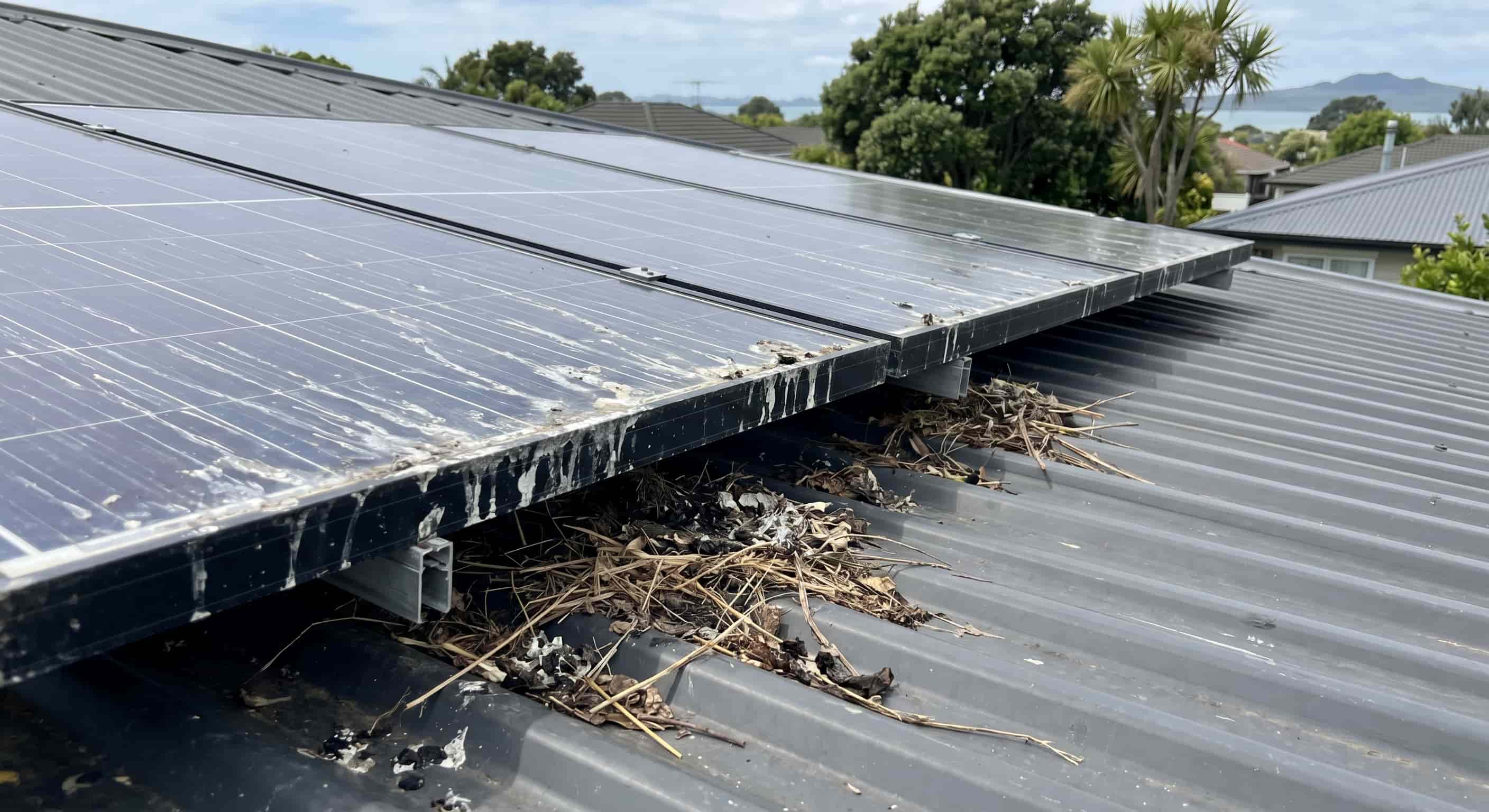
Birds nesting under solar panels is one of the more common causes of preventable output loss on New Zealand residential installations. Most homeowners don't know there's a problem until the damage is established. By that point, the system has been running below its potential for months, sometimes longer.
If you've noticed bird activity around your panels, or the system hasn't been looked at since it was installed, this article covers what's actually happening, what it costs you, and what the right sequence of steps looks like.
The gap between a solar panel and the roof surface is close to ideal nesting conditions. It's sheltered from rain and wind, protected from most predators, and the panels trap heat, so the cavity underneath stays warm through winter.
Pigeons are the most common problem on Auckland residential roofs. Once a pair settles in, they return season after season. They carry a strong spatial memory and can locate the same nesting site from considerable distances. Left undisturbed, a small colony grows.
Pigeons aren't the only species involved. Sparrows, mynas and starlings all nest under panels given the opportunity. Sparrows and starlings can access gaps too small for pigeons, which affects how mesh needs to be sized and fitted later.
The droppings you can see on the panels are the most obvious sign. They're also not the worst of it.
Bird droppings are highly acidic. Left on panel glass, they degrade the anti-reflective coating and can permanently etch the surface over time. A concentrated patch of droppings over a group of cells creates what's called hard shading. Those cells stop generating and instead absorb heat. The result is a hotspot: localised overheating that can crack the glass, damage the panel backing, and in serious cases create an electrical hazard. Lichen causes the same hard shading mechanism and compounds the damage over time. For a full explanation of how biological growth affects panel output and what professional treatment involves, see lichen, moss, and biological growth on solar panels.
Output loss from heavy biological fouling is measurable and meaningful. It won't show as a fault on your monitoring app, but before-and-after inverter readings taken during a professional service make it visible. For more on what that measurement captures and why the monitoring app misses it, see how dirty solar panels affect your output.
Nesting material creates a second category of damage. Panels need airflow underneath to regulate operating temperature. Twigs, leaves and feathers pack into the cavity and block that airflow. Panels running hotter than they should produce less electricity and wear faster. The same debris washes down into gutters, causing blockages and eventually water damage to the roof fascia.
The damage that surprises most people is wiring. Rodents, rats and possums in a NZ context, are attracted to the warmth and shelter that established bird nests create. Once they're on the roof, they chew through DC cabling. A single cable fault can take a string of panels offline entirely. That fault won't always flag clearly on a monitoring app. Rewiring is an electrician's job, and a costly one.
By the way — we built a free scorecard that shows how your heat pump, ventilation and solar are performing. Results are usually surprising.
Most solar monitoring apps report total output, not output relative to what the system should be producing. A system running well below its design capacity still shows generation. The number looks plausible. No alarm sounds.
This gap applies to any form of gradual solar performance loss. The system doesn't stop working. It works less well, quietly, across months and years, until something prompts a closer look.
Before-and-after inverter readings, taken at the start and end of a professional service visit, are the only objective way to see what the system is doing versus what it should be doing. Without them, you're reading an app figure with no baseline to compare it against.
The pest bird species present in New Zealand are the same introduced species found in Australian cities: feral pigeons, house sparrows, common mynas and starlings. All four are established across Auckland.
Pigeons are the most persistent for one specific reason: they don't respond reliably to deterrents once they've identified a nesting site. Visual deterrents, acoustic devices and reflective tape may reduce activity temporarily. They don't move an established colony on.
Starlings and sparrows bring a different consideration. Both can access gaps under panel frames that a pigeon can't fit through. A bird proofing job done for pigeon exclusion only may not keep smaller birds out. Mesh sizing matters, and it's worth confirming with the installer that the specification accounts for smaller species.
The instinct is often to call someone to fit mesh straight away. That's understandable, but it's the second step, not the first.
Before any protective mesh goes on, you need to know what the bird activity has actually done to the system. Fitting mesh over panels with existing acid damage, compromised cabling or degraded seals locks those problems in rather than resolving them.
A professional solar care visit inspects the full array before anything is cleaned or treated: panels, frames, mounting hardware, cabling, isolators and junction boxes. Existing damage is photographed and documented in a written condition report. Inverter output readings are taken before and after the service. Anything outside the scope of cleaning, including wiring damage or structural issues, is referred clearly in writing to a qualified electrician or your original installer.
That condition report gives you something concrete to act on. It documents what was present, what was recovered, and what still needs attention. It also gives a pest control specialist the information they need to scope a mesh installation properly, rather than quoting on assumptions.
For a full breakdown of what a professional service covers, see what a professional solar panel cleaning service includes in NZ.
Once the system has been inspected and any existing damage addressed, a physical mesh barrier is the most reliable long-term solution for keeping birds out.
Mesh is fitted around the perimeter of the panel array, secured with clips that attach to the panel frames without drilling. Done correctly, it doesn't void manufacturer warranties and doesn't restrict airflow underneath the panels. Professional installers typically price the job by the metre of perimeter rather than by panel count. Roof height, access difficulty and the extent of any existing infestation all affect the final cost. Get a quote from a qualified pest control specialist. For anything other than a straightforward single-storey roof, a DIY kit carries real safety risk and may leave gaps that smaller birds can still access.
Deterrents, plastic owls, acoustic devices, reflective tape and spikes, are considerably less effective than mesh for an established colony. Pigeons in particular habituate to visual and acoustic deterrents quickly. If birds have already nested under your panels, deterrents alone won't resolve it. Physical exclusion is the more reliable answer.
If you've noticed bird activity around your panels, or your system hasn't been inspected since installation, the right first step is understanding what condition the array is actually in.
The MiHT Home Energy Health Assessment takes a few minutes and gives you a clear picture of where your solar system stands before you decide what to do next. Bird-related damage is identified during a solar care visit and documented in a written condition report, giving you a clear starting point for any work the system needs.
Yes, in specific circumstances. Droppings are acidic and degrade the anti-reflective coating on panel glass over time. Concentrated droppings over a group of cells also cause hotspots: localised overheating that can crack the glass or damage the panel backing. Light contamination cleaned promptly is unlikely to cause lasting damage. Established fouling left across multiple seasons is a different situation.
A correctly installed mesh system won't void your warranty. The key is that clips attach to the panel frame without drilling into it. Any installation that penetrates the panel frame risks voiding coverage. Ask the installer specifically how the clips attach before the job begins.
Perching produces scattered droppings across the panel surface and surrounding roof. Nesting produces concentrated accumulation around the array edges, nesting material visible at the perimeter, and often noise from the roof during early morning. You may also notice feathers caught at panel edges. A professional inspection confirms what's present, including debris and wiring condition that isn't visible from the ground.
Most monitoring apps report total generation, not generation relative to what the system should be producing. A system running well below design capacity still shows output. Without before-and-after inverter readings from a professional service, there's no baseline to compare the app figure against.
Get the system professionally inspected first. A condition report documents what damage is present and records inverter output before and after cleaning. With that information, you can scope any electrical repairs through a licensed electrician and have a pest control specialist fit mesh to prevent a recurrence. Fitting mesh before knowing what's already there doesn't resolve existing damage.
Removing surface droppings from accessible panels is something some homeowners manage, though work at height carries real risk and contact with bird droppings warrants appropriate protective equipment. Removing established nesting material from under panels, inspecting cabling and hardware, and fitting mesh all require working on the roof around electrical components. A professional service is the right approach for anything beyond a ground-level visual check.