Before you go...
We built a free scorecard that shows how your heat pump, ventilation and solar systems are performing. Results are usually surprising.
Get my score
No thanks
We built a free scorecard that shows how your heat pump, ventilation and solar systems are performing. Results are usually surprising.
No thanksWe built a free scorecard that shows how your heat pump, ventilation and solar systems are performing. Results are usually surprising.
No thanks
Searching for HRV filter replacement or an HRV filter change in NZ often leads people straight to booking through HRV directly, but that's not the only option.
"HRV" is used two ways here: as the name of a specific brand (HRV, a New Zealand company), and as a generic term for any positive pressure ventilation system. The two are not the same thing.
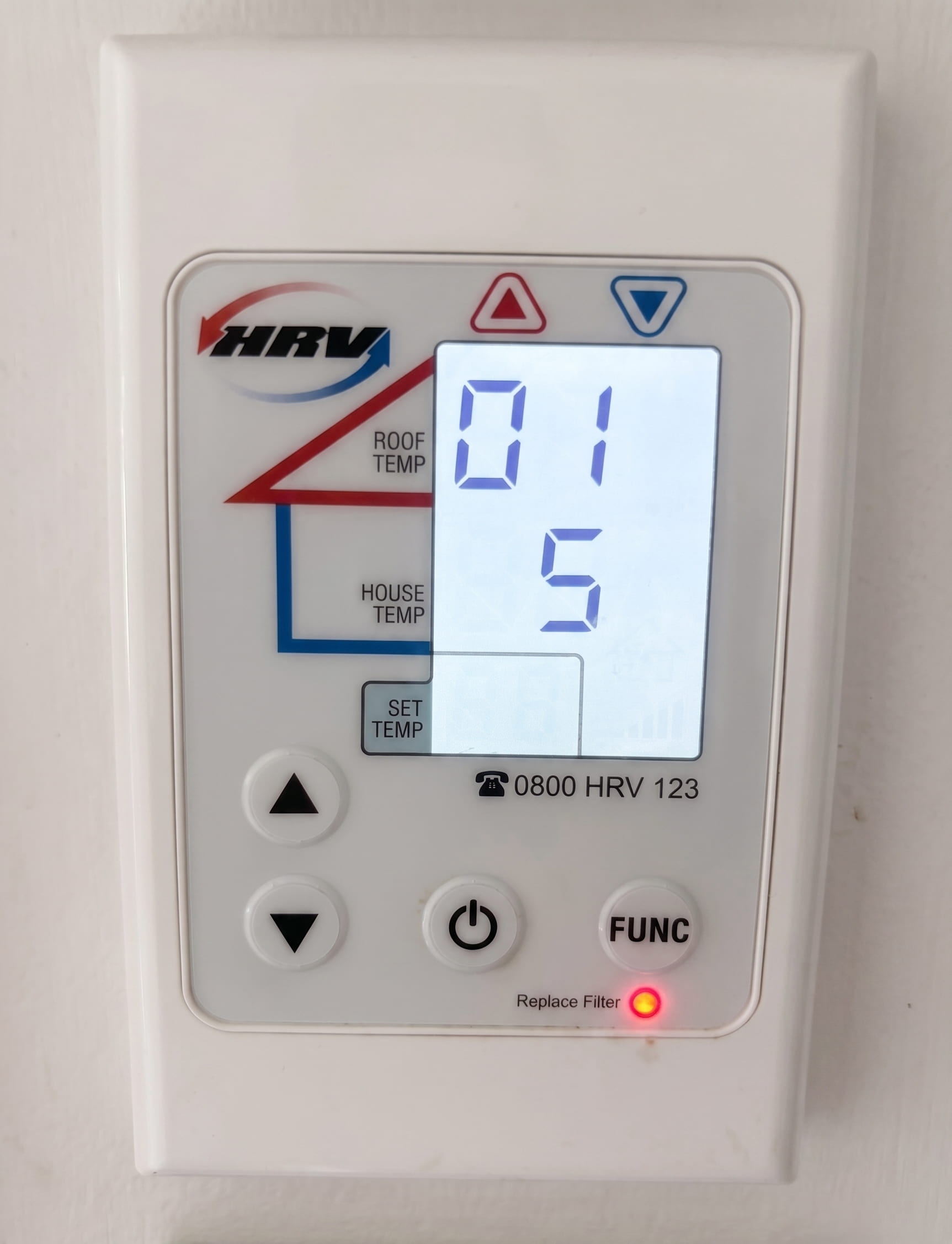
The clearest check is the wall controller in your home. If it carries the HRV brand, this article covers what you need to know. If it shows DVS, you'll find more relevant information in the DVS filter article. If it shows SmartVent, start with the SmartVent filter article instead.
For genuine HRV brand system owners: what follows covers what the filter does, how often to replace it, and what an HRV System Restore should include, from an independent provider rather than HRV direct.
For Auckland homeowners, the question comes up most often around the annual reminder light on the wall controller.
A full HRV system pulls air from the roof cavity through a filter and fan unit, then pushes it through ducting to ceiling diffusers in each room.
A new filter matters, but it's only part of the system. Roof cavity ducting develops leaks and disconnected joints over time, and a filter change on its own doesn't check for either. Air that bypasses a leak can reach the ceiling diffusers whether the filter is clean or not.
You don't need to book through HRV direct to get this done properly. MiHT is an independent, maintenance-only provider, no installs, no upselling to a new system, so the only recommendation on offer is what your existing HRV actually needs.
An HRV System Restore covers:
An HRV System Restore in Auckland typically runs $150 to $299, depending on system access and condition.
HRV is a New Zealand company that manufactures and installs home ventilation systems. The brand name has become so associated with positive pressure ventilation in general that many homeowners use it to describe any system that pushes roof cavity air into the living areas of the house.
This matters for maintenance. Filter grades, service requirements, and warranty conditions differ between brands. A filter specified for an HRV unit is not automatically appropriate for a DVS or SmartVent system.
An HRV positive pressure system draws air from the roof cavity, pulls it through a filter and a fan unit, then pushes it through ducts into ceiling diffusers in the main rooms. The air is not conditioned or exchanged with outside air. The pressure difference created by the incoming air pushes stale indoor air out through natural gaps in the building envelope.
The filter sits inside the fan unit. Its job is to remove dust, pollen, and roof cavity debris before air enters the home. A blocked or degraded filter reduces the volume of air reaching the rooms.
Systems installed before 2014 used a metal or galvanised steel fan box in the roof cavity. These Generation 1 units take an F7-grade filter, held in place with tape.
Systems installed from 2014 onwards use a plastic fan box. Generation 2 units take HRV filters F8 grade, secured with clips.
HRV's online shop currently sells an F8 filter marketed as compatible with Generation 1, 2, and 3 systems. HRV's published position is that this filter works across all generations.
A NZ trade supplier of compatible filters, the HVAC Shop, takes a different approach. They list a separate F7 product for Generation 1 units and a separate F8 product for Generation 2 units. They do not offer a single filter for both generations.
The underlying engineering principle is well-established. Generation 1 units use fixed-speed fan motors. These motors run at one speed and cannot adjust to compensate for increased airflow resistance. Fitting a higher-grade filter increases the static pressure the motor works against. Over time, that added load affects motor performance. HVAC professionals specify filter grades by equipment generation for exactly this reason.
HRV's published position and the grade-specific approach taken by independent trade suppliers give different answers on this point. Confirming which generation your unit is before ordering a filter is a straightforward step that removes the uncertainty.
Larger homes were occasionally installed with twin-fan units. Each fan requires its own filter.
HRV's published replacement interval for Classic and AirSense positive pressure systems is two years. This appears on their shop product pages.
There is an inconsistency within HRV's own published material. The AirSense FAQ page on the HRV website states a twelve-month interval, while the shop pages state two years.
Every other major NZ ventilation brand recommends twelve months. The HVAC Shop, which supplies compatible filters for both generations, notes on their product pages that filters last between twelve and twenty-four months depending on the environment, a range that reflects NZ roof cavity conditions rather than a fixed two-year cycle.
HRV's own guidance includes a caveat: environments with higher dust levels may require more frequent changes. Roof cavities in New Zealand accumulate insulation fibres, dust, and seasonal debris. The two-year interval assumes conditions that may not reflect what the filter actually encounters.
After replacing the filter, the indicator light on your HRV controller will not clear itself. The reset must be done manually through the controller menu. The exact steps vary by model, check your operating manual for the specific sequence. If the light stays on after the reset, the controller may need a power cycle before the change registers. Skipping the reset leaves the reminder active regardless of whether a new filter is in place.
Genuine HRV filters are $119 for the Classic, $139 for the AirSense, different products, not interchangeable, so confirm which one your system takes before ordering.
Compatible third-party filters are available from NZ suppliers including Supercell, Filtercorp, and HFS, typically $40–$80. Bunnings and Mitre 10 stock the Supercell G4, though it's a coarser grade than the F7 or F8 specified for HRV systems, confirm the correct grade for your unit generation before buying.
A cheaper filter only replaces one part. The duct run, diffusers, and airflow aren't checked by a filter swap alone, and those are the parts most likely to be quietly underperforming.
If condensation on windows is part of what prompted the filter check, condensation on windows in NZ: what causes it and how to reduce it covers the full range of causes.
Yes. An independent qualified technician can carry out an HRV System Restore using compatible third-party filters, without booking through HRV direct.
A genuine filter costs $119–$139 direct from HRV. A professional filter replacement using a compatible filter typically runs $150–$299 depending on the provider, and a full service — filter, fan housing, duct inspection, diffusers, and airflow check — costs more but covers considerably more ground than a filter swap alone.
Genuine HRV filters are sold directly through HRV: $119 for the Classic, $139 for the AirSense. These are different products, so confirm which system you have before buying. Compatible third-party filters from NZ suppliers such as Supercell, Filtercorp, and HFS typically run $40–$80, depending on grade and supplier.
The cost is the same whether you call it a replacement or a change — see how much HRV filter replacement costs in NZ above for the full breakdown by provider.
A full HRV positive pressure service should include: filter replacement at the correct grade, fan housing clean with fan blade inspection, a full ducting inspection across the complete duct run (not only around the fan unit), ceiling diffuser clean in each room, airflow check per room, and a written condition report. A filter swap alone does not constitute a full service.
The wall controller is the clearest indicator. HRV brand controllers carry the HRV name and are distinctively branded. If the controller shows DVS, SmartVent, or another name, you have a different brand of system. If the branding is unclear, a technician can inspect the fan unit in the roof cavity to confirm the manufacturer. Getting the brand right matters before ordering any filter or booking any service.
The fan unit itself identifies the generation. Generation 1 units, installed before 2014, have a metal or galvanised steel fan box. Generation 2 units, installed from 2014 onwards, have a plastic fan box. The generation determines which filter grade is appropriate. If you cannot access the roof cavity safely, a technician inspection confirms it.
The filter sits inside the fan unit in the roof cavity, not behind a grille in the ceiling or a panel in the house. Locating it means accessing the roof space directly. If you're not comfortable in a roof cavity, a technician can access and change it as part of a service visit.
No. HRV filters are designed as a consumable, not a washable or reusable filter. This is different from some heat pump filters, which are washable, so it's a common point of confusion. Replace rather than wash, on the schedule covered above.
The AirSense FAQ page on HRV's website states a twelve-month interval, while HRV's shop pages state two years for Classic and AirSense systems. Every other major NZ ventilation brand recommends twelve months. The HVAC Shop, a NZ trade supplier of compatible filters, notes that filters last between twelve and twenty-four months depending on the environment. HRV's own guidance acknowledges that dustier environments may require more frequent changes, which covers the conditions common to most NZ roof cavities.
Yes, and they're meaningfully cheaper , generally $40–$80 versus $119–$139 for genuine filters. Match the grade to your fan generation: F7 for Generation 1, F8 for Generation 2
Genuine filters are sold through shop.hrv.co.nz. Compatible third-party options are available from NZ suppliers including Supercell, Filtercorp, HFS, and the HVAC Shop, as well as Bunnings and Mitre 10 for the Supercell G4 grade. Match the filter grade to your fan box generation — F7 for Generation 1 (pre-2014, metal fan box), F8 for Generation 2 (2014 onwards, plastic fan box) — rather than buying by price alone.
If you have a Generation 2 unit (2014 onwards, plastic fan box), there's nothing to upgrade to — F8 is already the standard filter for these systems. The upgrade question really only applies to Generation 1 units (pre-2014, metal fan box), which are built for F7. HRV's online shop sells an F8 filter marketed as compatible across all generations, but Generation 1 units use fixed-speed fan motors that can't adjust for the extra static pressure a denser filter creates — over time, that added load affects motor performance.