Before you go...
We built a free scorecard that shows how your heat pump, ventilation and solar systems are performing. Results are usually surprising.
Get my score
No thanks
We built a free scorecard that shows how your heat pump, ventilation and solar systems are performing. Results are usually surprising.
No thanksWe built a free scorecard that shows how your heat pump, ventilation and solar systems are performing. Results are usually surprising.
No thanks
Installing a heat pump satisfies the Healthy Homes heating standard. Maintaining it is a separate obligation, and one that gets far less attention.
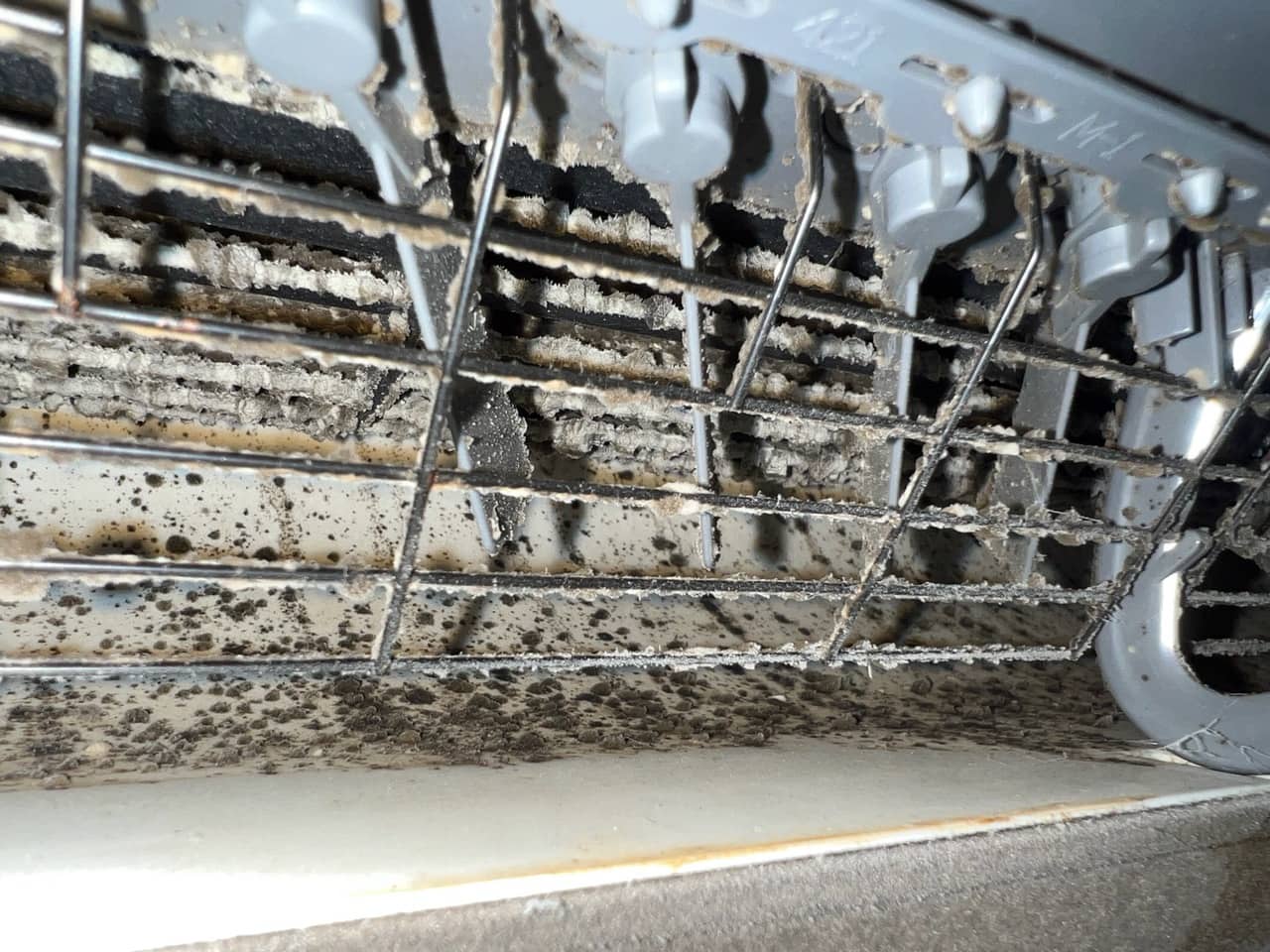
Mould inside a heat pump is common in NZ rental properties. It forms on the internal fan, the internal coil, and the drain pan; components that sit behind the filter and aren’t accessible without a professional service. When the unit runs, air passes across those contaminated components before it reaches the room.
This article explains where mould forms, what conditions cause it, what proper removal involves, and what a landlord’s position looks like when a tenant raises a health concern.
When a technician opens a heat pump that has mould inside, the first signs are usually on the internal fan. Black spotting or a greyish growth on the fan blades and the surrounding housing is the most common presentation. On the internal coil, mould tends to appear as a darker sludge where organic material has built up over time.
The drain pan sits at the base of the indoor unit and collects moisture that runs off the internal coil during cooling cycles. This area is often the most heavily affected, and it’s a significant source of the musty smell many people notice when the unit starts running.
Mould in a heat pump grows in three locations: the internal coil, the internal fan and its surrounding housing, and the drain pan.
Air drawn into the unit passes across the internal coil first. If mould is present there, spores enter the airstream before the air reaches the room. The internal fan is the next point of contact. Any growth on the fan blades or housing gets distributed with each rotation.
The drain pan sits below the direct airflow path, but mould on surfaces releases spores through air movement. Given the drain pan’s proximity to the coil and fan, spores from that area can enter the airstream as the unit operates.
Three conditions combine to produce mould growth: organic material, moisture, and warmth. A heat pump in regular use provides all three.
Running the unit in cooling mode during summer produces condensation on the internal coil. That moisture runs down into the drain pan. Over time, organic material from the air accumulates on the coil and the internal fan. Add warmth from heating cycles and mould has everything it needs.
Running a heat pump on auto mode, where the unit switches between heating and cooling to hold a set temperature, accelerates this. The constant cycling produces more condensation than using the unit in a single mode. Mould can develop more quickly under those conditions, and auto mode isn’t something we’d recommend for regular use.
Rental properties aren’t necessarily worse than owner-occupied homes as a rule. The difference is in maintenance consistency.
Many tenants have no idea that a heat pump has filters, let alone that the unit needs professional servicing. When a problem develops, the tenant’s option is to notify the landlord; they can’t book a service themselves. If nobody makes that call, the unit keeps running in whatever condition it’s in.
High tenancy turnover makes this worse. Each change of occupant resets whatever awareness the previous tenant had built up. A system can go years without a professional service, and the build-up inside stays out of sight until a technician opens it up.
Research published in peer-reviewed journals confirms that mould on indoor surfaces releases spores and particles into the air through passive aerosolization — a process driven by air movement. A heat pump actively moves air across its internal components, which makes contaminated units a direct source of airborne spores in the home.
The health effects depend on the occupants. People with respiratory sensitivities, asthma, or compromised immune systems are more likely to be affected. Others may not notice anything. What’s consistent across the research is that indoor spaces with mould contamination show higher airborne spore levels, and those elevated levels are associated with health problems for occupants.
There is no benefit to anyone breathing air that has passed through a mould-affected heat pump.
The most common assumption among landlords and property managers is that a clean filter means a maintained heat pump. The filter is the first layer of the system and catches a proportion of what the air carries. It doesn’t capture everything, and it doesn’t address what’s already built up behind it.
Organic material accumulates on the internal coil over time regardless of how consistently the filters are cleaned. The coil, the internal fan, and the drain pan are not accessible through a filter clean or a wipe-down of the front of the unit. A tenant who cleans the filter every four to six weeks can still have a heat pump with substantial mould growth on the internal components.
Removing mould from a heat pump requires access to the components a filter clean cannot reach. The process has three stages.
A pH-neutral chemical foam is applied to the internal coil and internal fan. The foam breaks down the mould, a layer of organic growth, and dirt that has built up on those components. It’s formulated to do this without damaging the surrounding plastics or electrical boards.
Once the foam has worked, a technician uses a battery-operated low-pressure sprayer to gently flush the coil and fan. The water and loosened debris wash down into a catch-bag fitted to the unit, keeping the surrounding area clean.
The condensate drain line is flushed separately to clear any blockages. Anti-mould tablets are placed in the drain pan to slow the return of slime and growth in that area.
None of this is accessible through a filter clean or a wipe-down of the front of the unit. The internal components need to be reached, treated, and flushed before the unit is reassembled and tested.
Mould inside a heat pump sits under two pieces of legislation, not one. The Healthy Homes Standards (Residential Tenancies (Healthy Homes Standards) Regulations 2019) cover moisture ingress, drainage, and ventilation. Sections 45 and 45A of the Residential Tenancies Act 1986 cover the landlord’s duty to provide premises in a reasonable state of cleanliness and repair. Both apply when a landlord has failed to maintain the systems they’re responsible for.
Tenancy Services is clear that landlords are responsible for servicing heat pumps and maintaining heating and ventilation systems. Internal component mould on the coil, fan, or drain pan is much closer to a landlord maintenance obligation than a tenant housekeeping issue. It involves the condition and operation of the appliance, not surface cleaning an occupant can reasonably do.
There is a grey area. A Tenancy Tribunal may consider whether the tenant has been cleaning the unit’s filters as a contributing factor if the evidence supports it. The practical point stands regardless: a landlord who has never booked a professional service is in a weaker position than one who has documented maintenance and acts when a problem is identified. To arrange a professional heat pump service across your rental portfolio, see our heat pump cleaning service.
Mould in NZ rental properties is one of the most common grounds for Tenancy Tribunal applications. Our own analysis of 348 Tenancy Tribunal decisions found cases involving heavy black mould resulted in penalties, work orders, and restraining orders. The penalty ceiling for a breach of the Healthy Homes Standards is $7,200 per breach, enforced under the Residential Tenancies Act 1986. Compensation orders sit on top of that figure in serious cases.
Mould inside a heat pump can be identified on routine inspection. A visual check of the internal fan and coil takes seconds during a standard property visit. Acting on what’s found and documenting the work is the most straightforward protection available to a property manager. For information on portfolio maintenance programmes, see our property managers page.
Mould inside a heat pump typically appears as black spotting or greyish growth on the internal fan and surrounding housing. On the internal coil it often presents as a darker sludge. The drain pan at the base of the indoor unit can also carry significant growth, which is a common source of the musty smell people notice when the unit runs.
Yes. When a heat pump runs, air passes across the internal coil and through the internal fan before entering the room. If mould is present on those components, spores enter the airstream. Research on indoor fungal contamination confirms that mould on surfaces releases spores through air movement — an operating heat pump actively creates that movement across contaminated components.
Internal component mould resulting from a lack of professional servicing is generally treated as a landlord maintenance obligation under both the Healthy Homes Standards and the Residential Tenancies Act 1986. Tenancy Services states that landlords are responsible for servicing heat pumps and maintaining heating systems. A Tenancy Tribunal may consider whether the tenant has been maintaining the filters as a contributing factor, depending on the circumstances.
No. A filter clean addresses the dust layer the filter has captured. It doesn’t reach the internal coil, the internal fan, or the drain pan, which are the areas where mould forms. Organic material accumulates on those components over time regardless of how regularly the filter is cleaned.
Professional mould removal involves a low-pressure wash of the internal coil and internal fan using a specialist cleaning solution. The drain pan and drain line are cleared and treated separately. An anti-algae treatment is applied to the drain pan to slow regrowth. This requires access to the internal components, which a basic service or filter clean does not provide.