Before you go...
We built a free scorecard that shows how your heat pump, ventilation and solar systems are performing. Results are usually surprising.
Get my score
No thanks
We built a free scorecard that shows how your heat pump, ventilation and solar systems are performing. Results are usually surprising.
No thanksWe built a free scorecard that shows how your heat pump, ventilation and solar systems are performing. Results are usually surprising.
No thanks
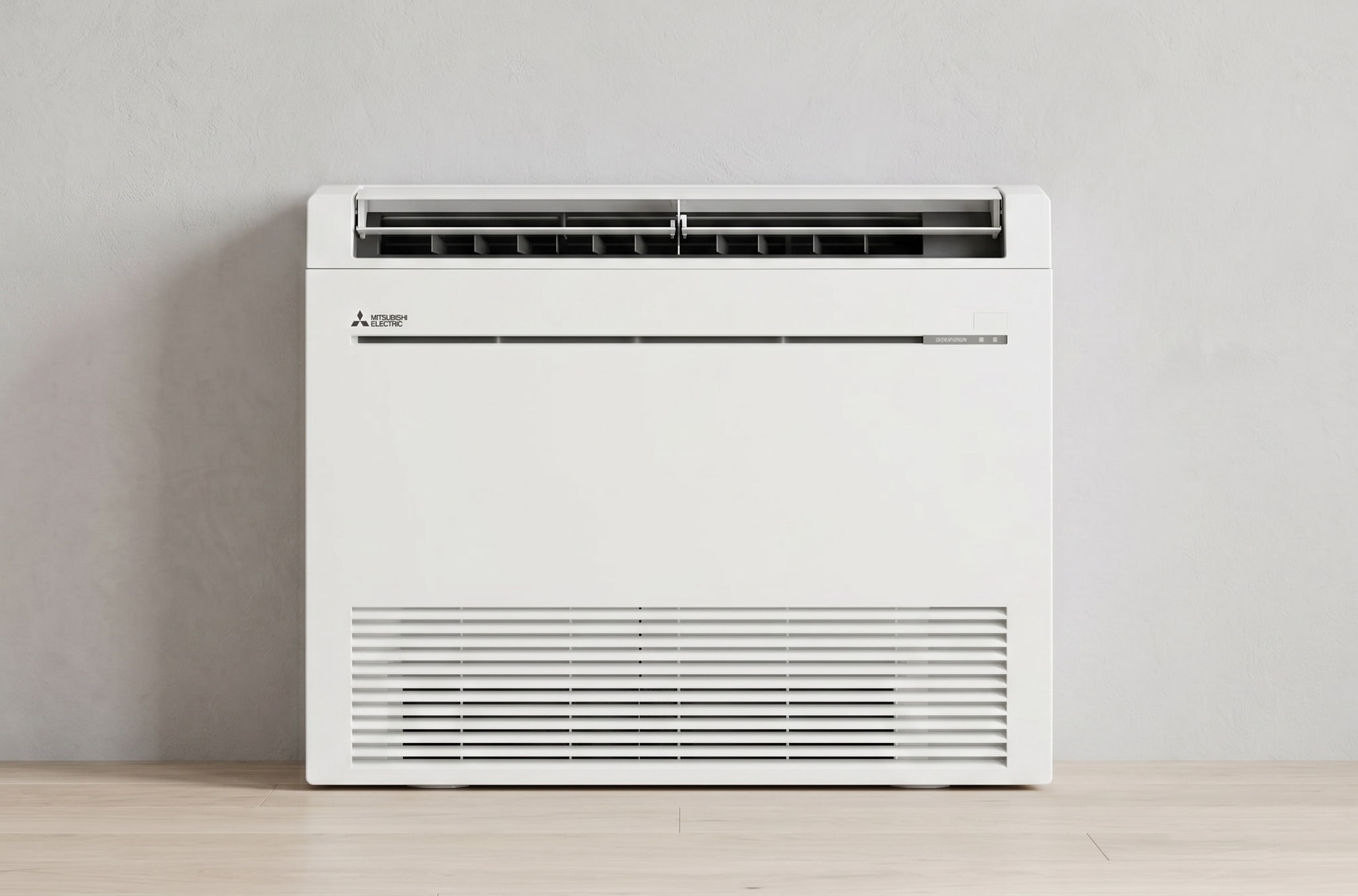
Your floor console heat pump is not serviced the same way as a wall unit, and the maintenance that matters most between professional visits is different too. The reason comes down to one physical fact: your unit draws air from skirting board level, and everything that settles on your floor goes through it first.
A wall unit mounted high on the wall pulls from the upper air in the room. Your floor console pulls from where dust, carpet fibres, and pet hair actually collect. That difference in intake height changes what builds up inside the unit over time, and it changes what a proper service needs to cover.
This article covers what makes a floor console service different, what the process involves, how often it needs to happen, and what you need to do yourself between professional visits.
Your unit's intake grille sits close to the floor because that is where the coldest air in the room settles. On every cycle, it draws whatever is in that air across the internal components. In a carpeted room, that includes carpet fibres, fine dust, and pet hair alongside normal airborne particles.
Your filter catches most of it. What bypasses the filter over months of daily use gradually builds up on the internal coil and in the lower fan assembly. This is the core difference between a floor console and a wall unit: the debris load at floor level is higher, and the internal components accumulate it faster. Regular filter cleaning by the owner is the primary way to manage this between professional services.
A full floor console service covers six areas: the internal coil, the fan assembly, the moisture tray, the drain line, the floor-level temperature sensor, and the outdoor unit. Each requires specific equipment and technique that goes beyond what an owner can do with a filter clean.
Your internal coil is cleaned with a specialist cleaning solution and a low-pressure rinse. At floor level, fine dust and organic matter compact into the coil fins differently than on a wall unit, and the cleaning process accounts for that.
Your fan assembly is cleaned to remove the combination of organic growth and physical fibre material that accumulates at the lowest point of the unit. This is the step that most clearly separates a floor console service from a wall unit service. The fibre that wraps around the fan blades over time requires physical removal, not just solution.
Your moisture tray and drain line are flushed and checked. A partial blockage in a floor console produces a faster backup than on a wall unit because the drain sits closer to floor level. A visible water leak at the base of the unit is a common sign that this has been left too long.
Your floor-level temperature sensor and outdoor unit are cleaned and checked as part of the same visit. Your technician should take a temperature reading at the intake and discharge before and after the service to confirm the system is transferring heat correctly.
For more detail on what a full professional service covers across all heat pump formats, see what a professional heat pump service includes in Auckland.
Your service interval for a floor console is annual, the same baseline as a wall unit. The difference is not the professional service frequency. It is what happens between professional visits.
Floor consoles run predominantly in heating mode. Because cooling cycles produce the moisture conditions that drive organic growth on the internal fan and in the drain system, floor consoles are generally less susceptible to biological growth than wall units running through Auckland summers in cooling mode. The contamination risk is primarily physical: carpet fibre, dust, and pet hair loading the filter and internal components on every cycle.
That makes your filter the critical maintenance point. On a wall unit, a four to six week filter clean is a recommended interval. On a floor console in a carpeted room, it is non-negotiable. The physical debris load at floor level is higher than at wall height, and a filter that is not cleaned regularly allows debris to bypass the mesh and accumulate on the internal components at a rate a wall unit owner does not experience.
Your filter should be checked every two to three weeks during heavy use periods and cleaned when it is loaded. Do not wait for the four to six week mark if the filter is visibly full before then. The filter condition is your most reliable indicator of what is happening inside the unit.
For owners who do run their floor console in cooling mode, the biological growth risk increases. Most floor console owners use them for heating only, and the units perform well in that application. Cooling is a viable option in the right setting, but owners running regular cooling cycles carry the same organic growth risk on the internal fan and in the drain system as any wall unit running through an Auckland summer.
By the way — we built a free scorecard that shows how your heat pump, ventilation and solar are performing. Results are usually surprising.
Your floor console running on restricted internal components uses more power to deliver the same heating output. As the internal coil and fan accumulate debris over time, the unit compensates by running longer cycles. A system operating at up to 25% below its designed efficiency adds that loss to every cycle it runs, across every month between services.
The compressor in your outdoor unit carries a related cost. A unit working harder than it should over an extended period puts sustained load on the compressor. The compressor is the most expensive component in the system and the one that determines whether a unit is worth repairing when it eventually fails. Keeping the internal components clean is the most direct way to protect it.
Your service record also matters beyond performance. A maintained unit with documented service history is in a stronger position at any warranty assessment and carries more value at the point of property sale than one with no maintenance history.
Your filter is the one component you can manage yourself, and on a floor console in a carpeted home it matters more than on any other heat pump type.
Your front faceplate unclips without tools. Press or lift the release tabs at the top corners, swing the panel open, and the filters slide out from their slots. Shake or tap them outside to dislodge loose dust before bringing them inside to wash. Rinse under warm running water, let them dry completely in a shaded area, and refit only when fully dry. A damp filter refitted into the unit creates conditions for organic growth behind it.
Your cleaning interval in a carpeted room should be every two to three weeks during periods of active use. If the filter is heavily loaded when you pull it, a professional service should not wait for the annual mark.
Your outdoor unit benefits from a quick visual check every few months. Clear any leaves, debris, or vegetation from around the unit casing. Nothing should be within 500mm of the unit on any side. If the fins on the outdoor coil are visibly bent, blocked, or showing signs of corrosion, note it for your next professional service.
For a step-by-step guide to filter cleaning on NZ heat pump models, see how to clean a heat pump filter.
Floor consoles are proportionally more common in South Island homes than anywhere else in New Zealand. The heating advantage at floor level makes them well suited to colder climates, and they are a common choice in Southland, Otago, and Canterbury homes where winter temperatures are consistently lower than in Auckland. The design draws cold floor-level air in and distributes warm air upward across the room, which suits those environments well.
Your floor console, wherever it is installed, was chosen for the same reason. It heats from the floor up, which is the most effective pattern for the way cold air actually behaves in a room.
Your obligations as a landlord are the same for a floor console as for any other heat pump format. The Healthy Homes Standards require the heating source to be in good working order throughout the tenancy. A floor console that has not been serviced and fails during a tenancy creates a compliance issue. Documented service records are the clearest evidence of maintenance if a dispute reaches the Tenancy Tribunal.
Your tenants are also less likely to clean the filter at the right frequency without guidance. Including filter cleaning instructions in your tenant onboarding and checking filter condition at inspections is worth the two minutes it takes. A floor console in a carpeted rental room with no filter cleaning between professional visits accumulates restriction faster than one in an owner-occupied home.
The cost of an annual professional service is a fraction of the cost of a repair or a compliance investigation. A floor console with a documented service history is a protected asset in your portfolio.
Your floor console is most likely one of a small number of brands that dominate the NZ residential market. Knowing your brand and model is useful when booking a service, ordering replacement filters, or checking your warranty terms.
Mitsubishi Electric sells the MFZ-KW and MFZ-KJ RapidHeat series. These are common in older Auckland and South Island homes where the unit sits in a cavity left by a removed fireplace or night-store heater. Daikin sells the FVXS and Aura series floor console lines. Fujitsu's AGTG and AGTV series are widely installed as night-store heater replacements across both islands. Panasonic also sells floor console models in New Zealand, with designs that sit low-profile against the wall and suit rooms where a discreet installation is a priority. Carrier covers floor console configurations under the same warranty terms as its hi-wall and multi-split products, with the 10-year residential warranty applying to units installed from June 2025.
Your brand label is on the inside of the front panel or at the base of the indoor unit. Your model number is what you need when contacting a service provider or ordering replacement filters. Your service process is the same regardless of brand. The faceplate removal method and filter access vary slightly between models, but the internal components that require cleaning are consistent across all of them.
Your unit after a proper service should heat the room more efficiently than it did before. The fan moves the volume of air it was designed to. The internal coil transfers heat without fighting through accumulated restriction. In a unit that has been running for two or more years without a service, the improvement in heating output is measurable within the first few cycles.
Your power draw reduces as efficiency is restored. Your service record is updated, which matters for warranty assessments and at property sale. Your floor console was installed to heat the room it sits in, for the years it was designed to last. A proper annual service and regular filter cleaning between visits is what makes that happen.
Yes. The faceplate removal process, the fan blade cleaning, and the moisture tray location all differ from a wall unit service. The most significant difference is the contamination type: floor-level air intake means the fan assembly accumulates a combination of organic growth and matted carpet fibre that requires physical removal, not just cleaning solution. The service process is not simply a wall unit service applied at a lower height.
Your internal fan or internal coil has accumulated organic growth. This is more common on units that run in cooling mode, as the moisture produced during cooling creates the conditions for growth on the internal fan. A filter clean will not resolve it. The internal fan and coil require a professional clean to remove the source. If your unit runs primarily in heating mode and still has a smell, the drain tray is the most likely source.
Your filter is the one component you can maintain yourself. Unclip the front faceplate, slide the filters out, rinse them with warm water, dry completely, and refit. The internal coil, fan, moisture tray, and drain line require a technician with appropriate cleaning solutions and equipment. Attempting to clean the internal coil without the right tools risks damaging the fin array.
The Healthy Homes Standards require the heating source to be in good working order throughout the tenancy. While they do not specify a servicing schedule, a floor console that fails due to documented neglect creates a compliance issue for the landlord. Regular professional servicing with documented records protects against Tenancy Tribunal disputes.
A full professional service on a floor console takes between one hour and one and a half hours on site. A visit completed in 20 minutes has not covered the full system. Duration is a reliable indicator of whether the internal fan, coil, and moisture tray have been properly addressed, or whether only the filter was cleaned.
Your manufacturer's warranty does not automatically lapse because a service was skipped. However, if a fault is assessed as resulting from documented neglect, such as a blocked drain that caused water damage or a restricted coil that contributed to component failure, the repair is unlikely to be covered. Mitsubishi Heavy Industries explicitly excludes faults from lack of maintenance to drains, filters, and heat exchangers in their warranty terms. A maintained unit with service records is in a stronger position at any warranty assessment.
Your floor console is designed to heat from the floor up, drawing cold air from the lowest point in the room and distributing warm air upward. In consistently cold climates this is a meaningful advantage over a wall unit. South Island homes in Southland, Otago, and Canterbury use floor consoles at a higher rate than Auckland homes for this reason. In Auckland, wall units dominate because the climate is milder and the heating advantage at floor level is less pronounced.