Before you go...
We built a free scorecard that shows how your heat pump, ventilation and solar systems are performing. Results are usually surprising.
Get my score
No thanks
We built a free scorecard that shows how your heat pump, ventilation and solar systems are performing. Results are usually surprising.
No thanksWe built a free scorecard that shows how your heat pump, ventilation and solar systems are performing. Results are usually surprising.
No thanks
A ducted heat pump in NZ conditions every room from a single unit installed out of sight. It runs quietly, handles the whole house, and when it's properly looked after, delivers consistent comfort across every season.
It is also the most complex system in the house, and the one most owners know the least about. Almost everything that matters is hidden. The air handler, the ductwork feeding every room, the drain system, the joins and seals holding it all together. None of it is visible from inside the house.
That gap between what the system does and what owners can see is what this article is about. Whether you've had a ducted system for years, just moved into a home with one, or are considering the investment, understanding what's up there and what it needs is the starting point for getting full value from it.
A wall-mounted unit is self-contained. Everything that matters sits on your wall or outside on the ground. You can see it, hear it, and clean the filter without tools.
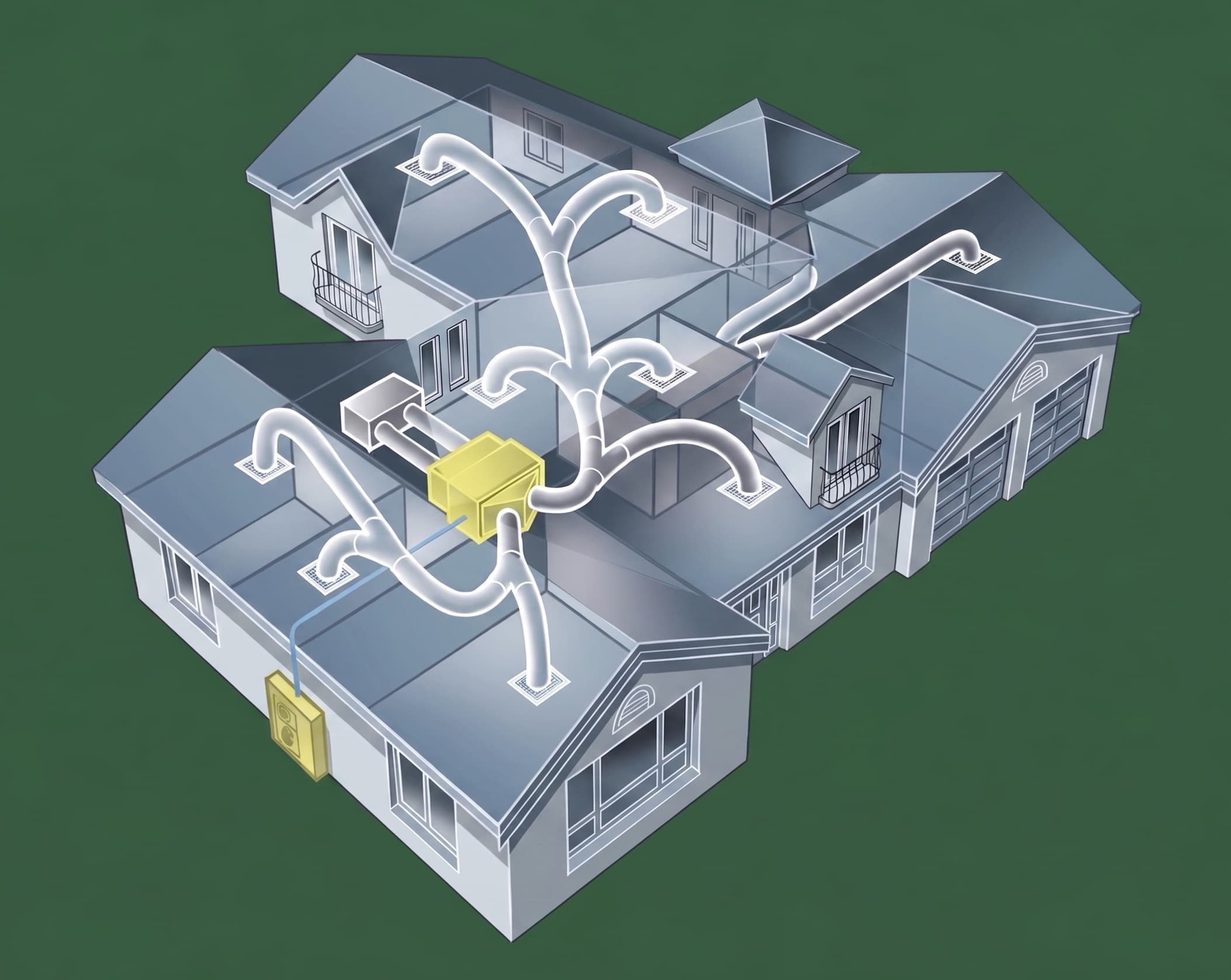
A ducted system is different. The air handler lives in your ceiling cavity or under your floor. Air is drawn back from the house through a return grille, conditioned inside the air handler, then pushed through a network of flexible insulated tubing to vents in each room.
The components in a typical NZ ceiling cavity installation include the air handler, the ductwork, the plenums (the box sections connecting the ducts to the unit), the drain pan and drain line, and in zoned systems (where different areas of the house can be controlled independently), the motorised dampers that control airflow to individual rooms.
For ceiling-mounted systems, supply vents sit in the ceiling of each room and the return air grille is typically a large hinged panel in the hallway ceiling. For subfloor installations, the air handler sits under the house, supply vents are in the floor, and the return air grille is usually set into a wall, often in a hallway or what was once a cupboard.
From inside the house, the only things you ever see are the controller, the supply vents, and the return air grille. Everything else is hidden.
The return air filter is a washable mesh screen that sits behind the return grille. Its job is to catch dust, hair, and airborne debris before the air reaches the air handler. Without it, that material builds up on the internal coil and internal fan, restricts airflow, and creates the conditions for organic growth in the drain pan.
In most Auckland ducted installations the filter is accessible from inside the house. For ceiling systems, the return grille is in the hallway ceiling. For subfloor systems it's typically in a wall grille at a low level. Either way, you unlatch the grille and slide the ducted heat pump filter out without needing roof or subfloor access.
Some installations mount the filter directly on the air handler itself rather than at the return grille. If that's the case on your system, leave filter cleaning to a technician.
To clean an accessible filter, vacuum it first before introducing any water. Dry dust is far easier to remove than wet dust that has been rinsed through the mesh and compacted. Once vacuumed, rinse with a garden hose or lukewarm water, spraying from the clean side of the filter through to the dirty side. Spraying from the dirty side drives debris further into the mesh rather than clearing it. Let the filter dry completely in the shade before refitting. A damp filter put back into the grille restricts airflow from the moment the system starts.
Clean the filter every four to six weeks during heavy use. The mesh itself wears out over time and every couple of years the filter media needs replacing. The aluminium frame is reusable.
Cleaning the filter regularly is the right thing to do. It is also the only maintenance task an owner can complete themselves. The internal coil, drain pan, drain line, and ductwork all require professional access and cannot be reached from inside the house.
One thing many owners aren't told at installation: the system relies on air returning freely to that return grille. Keeping bedroom doors closed while the system runs restricts that return path. Conditioned air gets trapped in rooms, the system works harder to compensate, and in some installations the thermostat reads the wrong temperature because warmed air can't reach the sensor. Leaving doors open or ajar while the system is running solves this.
By the way — we built a free scorecard that shows how your heat pump, ventilation and solar are performing. Results are usually surprising.
NZ roof spaces aren't conditioned. Summer temperatures inside a ceiling cavity regularly exceed 60°C. Winter drops it close to outside temperature. Everything installed up there cycles through those extremes year after year.
Flexible ductwork is the residential standard in NZ. Where joins were mechanically fastened before being taped, they hold well. Where tape was applied without mechanical fastening, it loses adhesion in sustained roof space heat and separates over time. Conditioned air goes into the ceiling cavity instead of the room it was headed for. On first professional visits to unserviced systems, separated joins are a consistent finding.
The less visible problem is an unsealed return plenum. When the return plenum isn't properly sealed, the system draws air from the ceiling cavity rather than from the house. That means insulation particles, roof space dust, and whatever else is up there entering the air handler and distributing through every room. The return grille in the hallway looks clean. What the system is actually pulling through it is a different question. This is The Healthy Home Blindspot in a ducted system.
A system losing conditioned air through separated joins runs harder to compensate and draws more power across every cycle. No single alert. No obvious symptom from inside the house. Just a slow efficiency loss that shows up on the power bill. This is The Set and Forget Cost at its least visible.
For a full breakdown of what a professional inspection covers inside the roof cavity and how duct integrity issues are identified and resealed, see what a ducted heat pump service involves.
A ducted system distributes air through the whole house from a single air handler. When something is producing a smell inside that unit, the fan carries it through the ductwork and out of every vent simultaneously. That's why a smell on a ducted system is a whole-house problem rather than a single-room one, and why it behaves differently from a wall unit where the smell stays in one space.
The most common cause is the drain system. When the system runs in cooling mode, the air handler produces moisture, which collects in a drain pan and exits through a drain line. Dust that gets past the filter mixes with that moisture and accumulates in the pan. A layer of organic growth develops. When the fan runs, the smell distributes through every vent simultaneously.
A blocked drain line makes this worse. When the drain line can't clear, water sits in the pan. The smell is persistent and travels further the longer the system runs. If the blockage isn't addressed, the pan overflows. Water damage to a plasterboard ceiling is the consequence.
Spraying coil cleaner into the unit does not fix a drain pan or drain line problem. The source of the smell is in the pan and the line, not on the coil surface. A professional inspection is required to clear it properly.
Internal coil contamination can also produce smell on a ducted system, though it's less common than on wall units. The pattern is the same: organic growth on the coil surface, distributed through the ductwork to every room.
A smell that appears briefly on startup and then clears is different from a smell that persists throughout operation. Persistent smell warrants professional inspection. For the full picture of how a ducted system affects indoor air quality, including the return air pathway risk: see heat pump indoor air quality NZ.
The outdoor unit on a ducted system is heating or cooling every room simultaneously. That's a significantly heavier workload than a single wall unit serving a single room.
Most ducted heat pump owners don't clean the outdoor unit between services. In non-coastal locations that's a manageable risk. In coastal Auckland, it's a more serious one.
Salt in the air accelerates corrosion on the outdoor coil and cabinet. Electrical components, particularly the circuit boards, are the first to fail. Good brands apply a blue fin coating to the outdoor coil as standard protection. Even with coating, anti-corrosion spray applied regularly slows the deterioration. Without it, salt accumulation is continuous and the damage compounds silently.
Mitsubishi Electric recommends washing the outdoor unit every six months using standard car wash liquid and a hose. Never dishwashing liquid. For coastal Auckland properties, they note that more frequent maintenance may be required.
Every one to two years, depending on how hard the system runs and the conditions in the roof cavity.
This is the same guidance as for a wall-mounted unit. The practical difference is that a ducted system has more components, more potential failure points, and operates in an environment that accelerates wear between services. There is more to find on a first visit to an unserviced ducted system than on a comparable wall unit.
For coastal Auckland properties, annual servicing is the appropriate interval. Salt exposure accumulates quickly enough that a two-year gap creates real risk to the outdoor unit.
For a system with no service history, whether inherited when buying a home or simply never booked, a full professional service is the right first step. It establishes what condition the system is actually in and identifies anything that needs attention before it becomes a failure.
There is genuine cynicism in the market about whether professional ducted servicing is worth the cost, and some of it is earned. A filter clean and a quick visual check is not a ducted service. A full ducted service involves getting into the roof cavity, inspecting and resealing duct joins and plenums, cleaning the internal coil and drain pan, clearing the drain line, and checking every supply vent in the house. For a breakdown of what that work actually involves, see the article on what a ducted heat pump service covers.
Whether you've owned a ducted system for years or have just inherited one, these are the signs that warrant a closer look.
Rooms that take noticeably longer to reach temperature than they used to. Not a seasonal variation, but a clear change in how long the system needs to run before a room is comfortable. Uneven results across the house, where some rooms perform well and others don't regardless of how long the system has been running.
A power bill that's risen across comparable billing periods without an obvious change in use. A system losing conditioned air through separated duct joins or an unsealed plenum draws harder to compensate. That extra load appears on the bill before it shows anywhere else.
A smell on startup that travels through multiple rooms, particularly a musty or stale smell that persists past the first few minutes of operation. A smell that gets worse when the system switches to fan or cooling mode often points to the drain pan rather than the coil.
Noises that weren't there before. Rattling from a supply vent, vibration from the air handler, or sounds that change with airflow all indicate something has shifted inside the ceiling cavity.
The least visible symptom is also the most common finding on first professional visits: duct integrity issues that have been sending conditioned air into the ceiling cavity, sometimes for years, with nothing obviously wrong from inside the house.
A ducted heat pump that's properly maintained and correctly used runs every room evenly, costs what it should to run, and lasts significantly longer than one that's been left to manage itself.
Most of the things that degrade a ducted system quietly over time are fixable. Separated duct joins can be resealed. Drain pans can be cleared. Filters can be replaced. The gap between a system that's struggling and one that's performing as it was designed to is usually a single professional service and a clearer picture of what's actually up in the ceiling.
By the way — we built a free scorecard that shows how your heat pump, ventilation and solar are performing. Results are usually surprising.
In New Zealand, the terms are used interchangeably. Almost all residential ducted systems installed here are reverse-cycle, meaning they heat in winter and cool in summer using the same equipment. If someone in NZ refers to their ducted air conditioning system, they are almost certainly describing a ducted heat pump. The distinction between the two terms matters more in markets where cooling-only systems are common. In NZ residential, cooling-only ducted systems are rare.
Yes, if the filter is accessible from a return grille inside the house. Vacuum the filter first to remove dry dust, then rinse with a garden hose, spraying from the clean side through to the dirty side. Dry it completely in the shade before refitting. The filter is the one maintenance task owners can handle themselves. The internal coil, drain pan, and ductwork all require a professional.
Usually you can't tell from inside the house. A system with separated duct joins still heats and cools. Rooms that take longer to reach temperature, uneven airflow between rooms, and a power bill that's risen without an obvious reason are all possible signs. A roof cavity inspection is the only way to confirm. On first professional visits to unserviced systems, duct integrity issues are a consistent finding.
Cleaning the filter removes what's caught in the mesh. It doesn't reach the drain pan, drain line, or internal coil, which are the most common sources of persistent smell on a ducted system. A musty or dirty smell that travels through multiple rooms usually points to the drain system. Coil spray applied without clearing the drain pan and line doesn't fix the underlying cause. A professional inspection is required.
Uneven temperatures across rooms are usually caused by one of three things: a duct join that has separated and is losing airflow to that zone, a supply vent that is partially blocked or closed, or a zone damper that has drifted out of calibration. In some cases, keeping bedroom doors closed while the system runs is enough to disrupt airflow balance across the house. A roof cavity inspection is the most reliable way to identify the cause.
A ducted service costs more than a wall-mounted unit service because it takes longer and involves getting into the roof cavity or subfloor.
Yes. A full ducted service includes a roof cavity inspection, duct join and plenum checks, internal coil and drain pan cleaning, drain line clearing, and supply vent cleaning. Cleaning the filter alone is not a ducted service. For the full breakdown of what each step involves, see what a ducted heat pump service covers.
Start with the filter. A blocked return air filter is the most common cause of reduced performance on ducted systems and is something you can check yourself. If the filter is clean and the system is still not heating or cooling properly, rooms are uneven, or the system is running constantly without reaching temperature, the cause is most likely inside the ceiling cavity. A professional inspection will identify whether it's a duct integrity issue, a drain problem, or something with the air handler itself. If the system has stopped working entirely and shows an error code, note the code and contact a technician. For a breakdown of what a professional service involves, see what a ducted heat pump service covers.